Updated 16 October 2026. Prepared by Ecoware’s marketing team. Test limits come from the certifiers’ published scheme documents; decay data from the cited technical literature.
Short answer: Bamboo cutlery has no single decomposition time; it depends on the disposal route.
- Industrial composting: items certified as compostable must disintegrate within 12 weeks (84 days) in a test at 58 ± 2 °C (BPI; TÜV Austria).
- Home composting: items certified for home composting must disintegrate within 6 months at 20 to 30 °C (OK compost HOME scheme).
- Backyard heap, uncertified cutlery: no test limit applies.
- Soil: untreated bamboo cane typically lasts 1 to 3 years in contact with soil before decay ends its useful life, and 4 to 6 years under cover (Janssen, Bamboo Preservation, Practical Action).
- Landfill: no reliable figure. The US Federal Trade Commission treats landfill as a place where complete decomposition within one year does not happen (FTC Green Guides, 16 CFR 260.8).
The composting figures are pass limits for certified products, not average times. “Disintegrate” means no more than 10% of the material is left on a 2 mm sieve. Coatings, glue, plastic binders and extra thickness slow the process down or stop it.
Decomposition time by disposal route
The table gives the same routes with what each figure measures and where it comes from:
| Where it ends up | What the evidence says | Source |
|---|---|---|
| Industrial composting, certified item | Must disintegrate within 12 weeks: no more than 10% of the material left on a 2 mm sieve. The separate 90% biodegradation test applies to plastics; untreated natural materials are exempt from it | TÜV Austria comparison of compostability standards; BPI certification |
| Home composting, certified item | Must disintegrate within 6 months at 20 to 30 °C; the 12-month biodegradation test again applies to plastics, not untreated natural materials | TÜV Austria OK compost HOME scheme |
| Backyard heap, uncertified cutlery | No test limit applies. Thickness, coating, moisture and how often the heap is turned decide | No published test limit |
| Untreated bamboo in contact with soil | Typical service life before decay: 1 to 3 years; 4 to 6 years under cover | Janssen, Bamboo Preservation, Practical Action |
| Landfill | No reliable figure. The US Federal Trade Commission treats landfills as places where complete decomposition within one year does not happen | FTC Green Guides, 16 CFR 260.8 |
The test limits are pass marks, not average results. A certified product has shown it can meet them at the thickness that was tested; a real composting facility may be faster or slower.
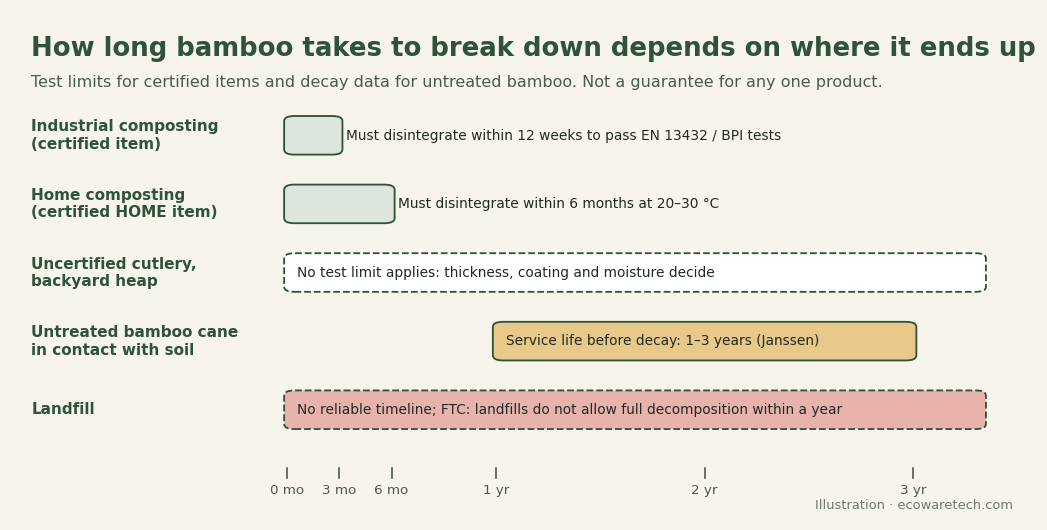
Illustration built from the table above. Generated for this guide.
Why the numbers differ so much
Published bamboo figures range from 12 weeks to several years because they measure different things: test limits versus field conditions, thin cutlery versus thick cane, and service life versus complete breakdown.
- Heat and management. Industrial composting runs hot and is turned and watered. BPI tests commercial compostability at 58 ± 2 °C with up to 84 days for disintegration, and its home test runs at 25 ± 2 °C for up to 180 days; the OK compost HOME scheme tests at 20 to 30 °C with a six-month limit.
- Size and thickness. Decay works from the surface inward. A thin spoon has far more surface for its weight than a pole. Most compostability standards treat items thinner than the tested sample as automatically covered, so a thicker version is not covered by the same result, according to TÜV Austria’s comparison document.
- Durability versus disappearance. The 1 to 3 year figure for bamboo in soil measures how long a structural piece stays usable, not how long until nothing is left. It is useful as an upper reference for thick, untreated bamboo, not as a forecast for cutlery.
What slows bamboo cutlery down
Five factors decide whether a bamboo fork, or any other bamboo tableware, behaves like a natural material or like something slower:
| Factor | Effect | What to ask a supplier |
|---|---|---|
| Surface coating (lacquer, wax, varnish) | Can slow or stop breakdown; a coated item is no longer only a natural material | “Is the item uncoated? If not, what is the coating?” |
| Glue or binder | Laminated or pressed items depend on what holds them together | “Is any adhesive or binder used?” |
| Plastic blended with bamboo fibre | The plastic decides the outcome; bamboo-melamine items are a resin with bamboo filler, not bamboo | “Is this solid bamboo or a composite?” |
| Thickness | Thicker pieces take longer and may fall outside a certificate | “What maximum thickness does the certificate cover?” |
| Disposal route | A compostable item sent to landfill behaves like landfill waste | “Where will our customers’ waste actually go?” |
If a product sold as “bamboo” feels like smooth plastic, read is bamboo melamine safe before assuming it will compost.
Does uncoated bamboo need a certificate to be called compostable?
Uncoated bamboo cutlery needs a certificate to be labelled compostable in some markets but not in others: Washington exempts products made only of wood, with no plastic, coating or wax, from its compostable-labelling requirements (Washington Department of Ecology), while California requires certification where an approved certifier and an applicable standard exist (California Public Resources Code §42357).
Under EN 13432, chemically unmodified materials of natural origin, such as untreated wood, are deemed biodegradable without testing; TÜV Austria notes they would not actually reach 90% within the test period. Disintegration, heavy-metal limits and ecotoxicity still have to pass before a product can be certified. The natural material is not the obstacle; the label is.
The word on the pack matters as much as the certificate. California bans “biodegradable” on products, including utensils (California Public Resources Code §42357), and France bans “biodégradable” on products and packaging (AGEC law, via INERIS). The difference between the two words is covered in biodegradable vs compostable cutlery, and the two certification levels in home compostable vs industrial compostable. For the certification marks by market, see compostable certification by market.
Will a composting facility accept bamboo cutlery?
A composting facility decides for itself which items it takes; certification shows a product can break down, not that a facility will accept it. The US Environmental Protection Agency notes that not all composting facilities accept compostable plastics, and in a North American field-testing programme, wooden cutlery was a custom item added by participating composters, with no item-level results for it in the programme’s May 2026 summary. If your compostability claim depends on a specific facility, get that facility’s acceptance in writing.
Checklist for bamboo cutlery buyers
- Material breakdown by weight, and a statement that no coating, glue or plastic binder is used, or which one is.
- The certificate number and the maximum thickness it covers, if you will print “compostable”.
- Written acceptance from the composting facility your customers use, if your claim depends on it.
- Label wording checked for each market the pack is sold in.
- Moisture and mould controls for storage, because damp bamboo can go mouldy before it is used. See mould on wooden cutlery.
- The certificates the factory actually holds; ours are listed on our factory page.
For the material itself and how long wooden and bamboo cutlery last compared with plastic, read what wood is wooden cutlery made of.
Common questions
Can you put bamboo cutlery in a compost bin? Uncoated bamboo cutlery can go in a home compost bin, where certified home-compostable items must disintegrate within 6 months at 20 to 30 °C; uncertified pieces have no test limit. A collected food-scrap bin works only if the facility behind it accepts the item.
Does bamboo decompose? Yes. Untreated bamboo is a natural material that microorganisms break down; the time depends on the route, from 12 weeks as a test limit in industrial composting to years for thick cane in soil.
Ecoware does not claim a compostability certification for its cutlery lines. If you need a compostability certificate for a specific SKU and market, say so when you request a quote.
How this guide was made: drafted with AI assistance and edited by Ecoware’s marketing team in October 2026. Test limits come from TÜV Austria and BPI documents; decay data from Janssen’s technical brief for Practical Action; legal statements from the FTC Green Guides, the California Public Resources Code, Washington’s Department of Ecology and the French AGEC law; each is linked where it is used. No decomposition testing was carried out for this article. The illustration is generated.
Get a quote from the factory
Ecoware ships disposable wooden and bamboo tableware made from logs at our family factory in Shucheng County, Anhui, in production since 2008. Stock items have no minimum order; for custom logo or packaging, the MOQ depends on the packaging and is confirmed in the quote. Samples are free and stock samples can ship the same day; custom orders get a confirmed ship date with the quote, based on packaging and quantity.
- Compostable bamboo plates — wholesale
- Bamboo tableware — full range
- Send us your requirement — product, quantity, logo and packing; we reply with pricing, lead time and a sample plan
Related Articles
- Bamboo Tableware: A Sustainable Shift That Transforms Lives
- Bamboo Cutlery Sustainability: The B2B Buyer’s Risk & Cost Analysis
- How Global Buyers Evaluate Disposable Wooden & Bamboo Cutlery Manufacturing
- Are Wooden Plates Safe to Eat On? Wooden Plates vs Plastic, Metal and Ceramic
- BPI Certified vs EN 13432 vs OK Compost: Compostable Certification by Market
- Browse all articles & products →
Products in this guide
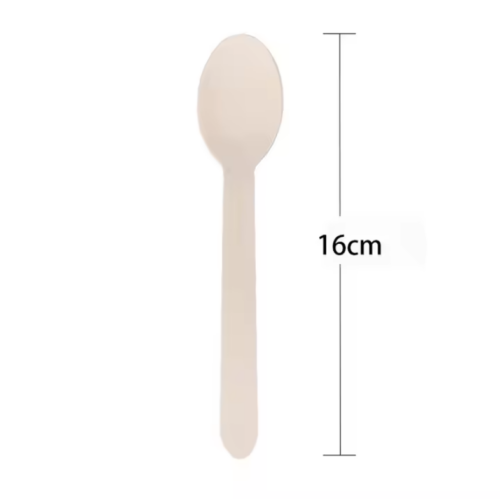
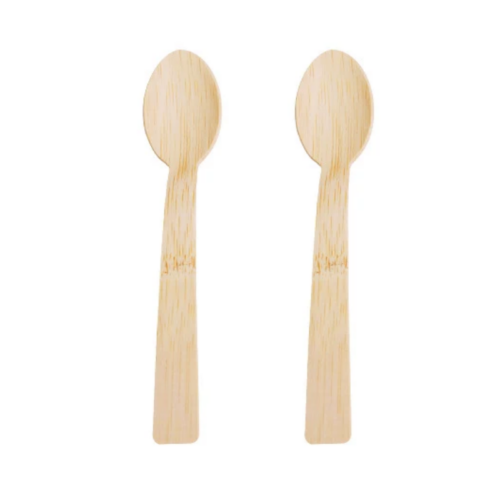 Disposable Bamboo Spoon 6.7 Inch
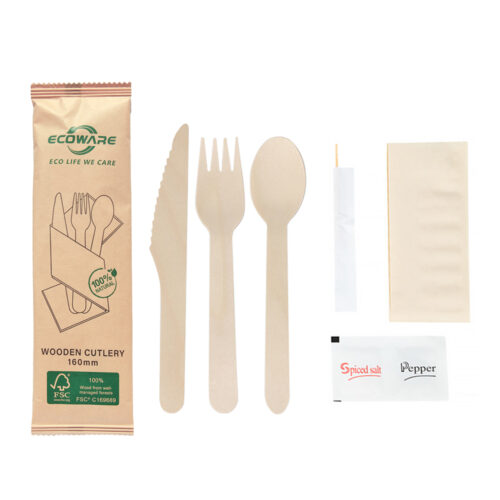
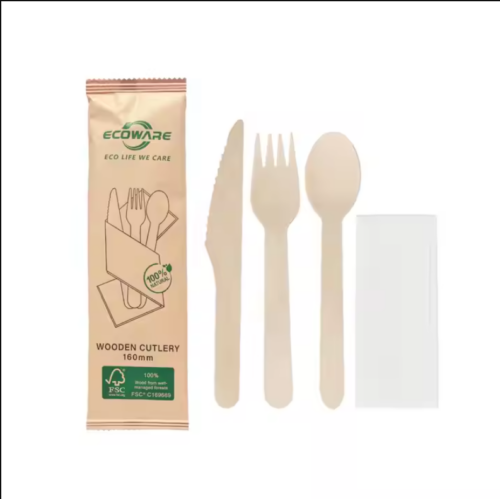
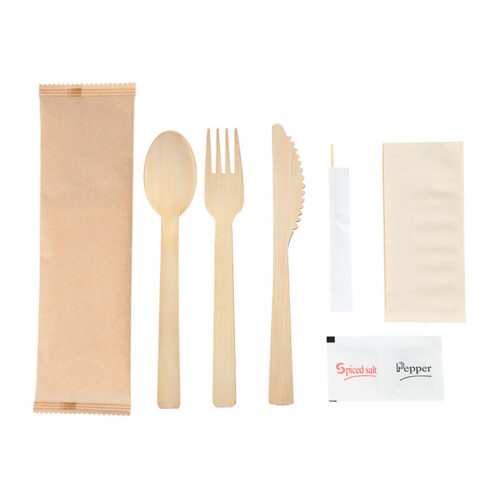 6 in 1 Wrapped Disposable Bamboo Cutlery Set
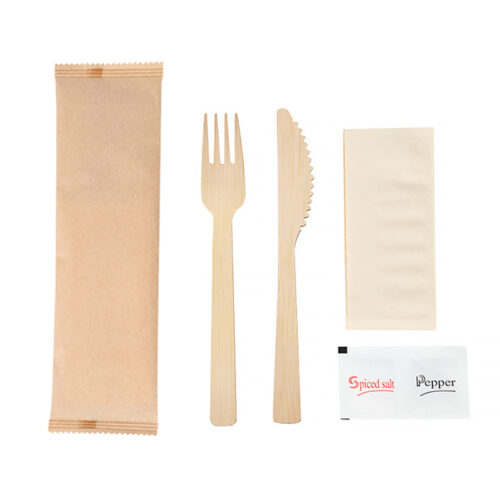 5 in 1 Bamboo Cutlery Set (knife + fork + salt + pepper + napkin)
See all Disposable Bamboo Cutlery Set → Request free samples →