Updated 1 October 2026. Prepared by Ecoware’s marketing team. Every regulatory statement links to the authority that made it.
Short answer: Bamboo melamine is not bamboo tableware. It is melamine-formaldehyde resin, a plastic, with ground bamboo fibre mixed in as a filler. In the European Union it is not a legal food-contact material at all: bamboo is not an authorised additive for plastics, and an EU-wide enforcement action ending in April 2022 found hundreds of these products on the market. Germany’s Federal Institute for Risk Assessment (BfR) found that hot drinks and meals can draw harmful amounts of melamine and formaldehyde out of these items, often more than from ordinary melamine ware, while cold or lukewarm food posed no health risk. Utensils cut from solid bamboo are a different material and are not covered by these warnings.
What “bamboo melamine” actually is
The BfR describes this “bamboo ware” as tableware made of melamine-formaldehyde resin that contains bamboo fibres as filler. The resin is what holds the cup, plate or children’s bowl together; the bamboo is ground into a powder or short fibres and blended in. That is why these products can be moulded into smooth shapes in bright colours, and why they are usually sold as reusable and often as dishwasher-safe.
The marketing rarely says “plastic”. The European Commission notes that these products are often presented as “natural”, “eco-friendly”, “compostable” or “recyclable”, and the Food Safety Authority of Ireland adds “organic” and even “100% bamboo” to the list of labels it has seen on them.
What regulators have found
| Authority | Position | Source |
|---|---|---|
| European Commission | Plastic food-contact products containing bamboo and other plant-based additives are not authorised, because those additives are not on the EU’s list for plastics. A coordinated action across 21 countries, which ended in April 2022, recorded 748 cases, 104 of them refused at the border. The same page shows cutlery made of 100% bamboo as legal | EU “Bamboo-zling” coordinated action |
| Germany, BfR | Hot liquids can release harmful amounts of melamine and formaldehyde from bamboo ware, often more than from conventional melamine resin, with health-based guidance values exceeded up to 120 times in individual cases; for cold or lukewarm food there is no health risk | BfR press release, 25 November 2019 |
| United Kingdom, FSA and FSS | Businesses in Great Britain should keep plastic food-contact products containing bamboo off sale; the advice does not apply to items made solely from bamboo or other plant materials | Food Standards Scotland notice, 30 July 2024 |
| Ireland, FSAI | Ground bamboo and bamboo flour are not authorised for use with plastic food-contact materials; items made solely of bamboo are permitted | FSAI guidance |
| United States, FDA | No bamboo-specific rule. Melamine-formaldehyde resins for molded food-contact articles are covered by 21 CFR 177.1460, which names refined woodpulp as a permitted filler and does not mention bamboo. FDA advises not to heat food on melamine dinnerware in a microwave | FDA, Melamine in Tableware Q&A |
The EU has also been tightening rules on plant fillers it once allowed: Regulation (EU) 2023/1442 removed untreated wood flour and fibres from the list of authorised plastic additives, with transitional arrangements set out in Regulation (EU) 2025/2240.
So the answer to “is bamboo melamine safe” depends on where you are asking. In the EU, Great Britain and Ireland, the question for a business is already settled: these products should not be sold. In the US, it is a melamine dinnerware question, and the FDA’s own advice about heat applies. Sellers into California should also note that formaldehyde is on the Proposition 65 list.
Why heat matters: the migration numbers
Two substances are measured when melamine tableware is tested, and the EU sets a specific migration limit for each:
| Substance | EU limit for plastic food-contact materials | Where the limit comes from |
|---|---|---|
| Melamine | 2.5 mg per kg of food | Regulation (EU) No 1282/2011, amending the plastics regulation |
| Formaldehyde | 15 mg per kg of food, as a group limit expressed as formaldehyde | Regulation (EU) No 10/2011, as amended |
The BfR’s opinion No 046/2019 assessed official control results for 366 cups and bowls, 228 of them bamboo ware, each tested three times in a row with 3% acetic acid for two hours at 70 °C. In the third test, 31% of the bamboo-ware samples exceeded the 15 mg/kg formaldehyde limit, against 5.8% of the conventional melamine items. Melamine release increased from test to test, which the BfR read as the material breaking down with use. It concluded that melamine resin tableware is unsuitable for microwave use and recommended lowering the formaldehyde limit from 15 to 6 mg/kg (BfR opinion on fillable articles made from melamine-formaldehyde resin).
A Dutch study by the food safety authority NVWA, published in Chemosphere in 2022, tested 46 cups made from melamine resin with bamboo fibre or powder: 88% stayed within the 15 mg/kg formaldehyde limit, but some released more than 200 mg/kg (Bouma et al., Chemosphere 292:133439).
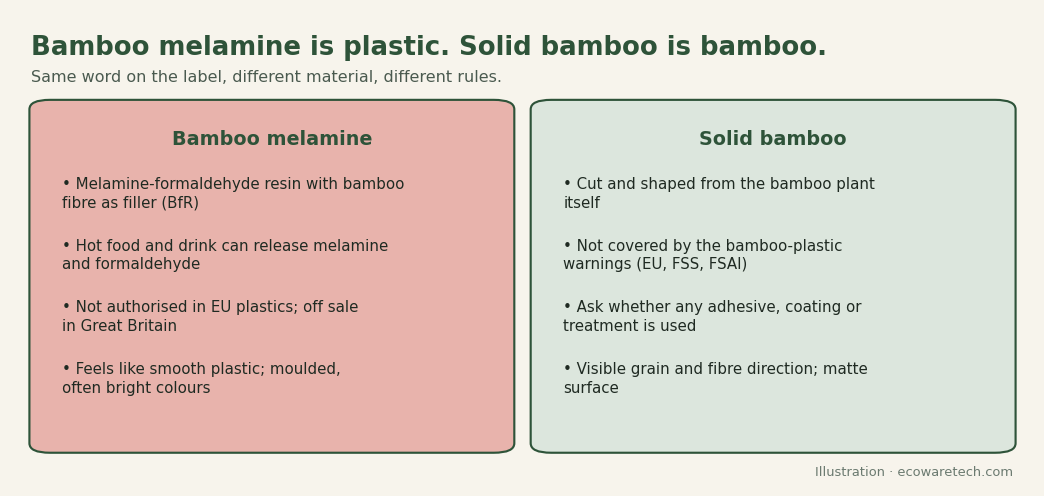
Illustration: what each material is made of and where the migration concern sits. Generated for this guide.
How to tell bamboo melamine from solid bamboo
Most buyers meet both materials as product photos and samples. These checks work in hand and on paper:
| Check | Bamboo melamine | Solid bamboo |
|---|---|---|
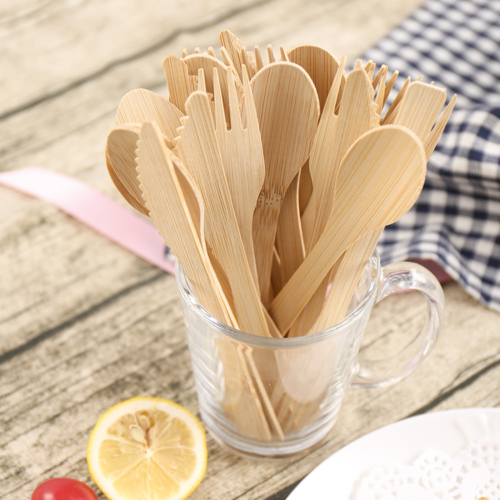
| Feel and surface | Smooth, plastic surface; the Commission notes “their feel is that of plastic” | Visible grain, fibre direction and sometimes node marks; matte or lightly oiled |
| Shape and colour | Moulded shapes, bright colours, printed patterns, thin even walls | Shapes limited by the cane or strips it was cut from; natural colour range |
| Product claims | “Bamboo fibre”, “eco”, “natural”, reusable and dishwasher-safe | Varies; ask for the material in writing |
| Paperwork | A plastics declaration of compliance and melamine/formaldehyde migration results; in the EU, these products cannot be compliant | A material declaration stating bamboo with no resin binder, plus any treatment or adhesive used |
When the only evidence is a photo, ask for the material composition in writing. A supplier selling bamboo melamine has a formulation sheet listing the resin; a supplier selling solid bamboo should be able to state that no melamine or other resin is used.
What about formaldehyde in solid bamboo products?
The warnings above are about melamine resin. Solid bamboo is a different case, but it is not automatically free of chemistry. Laminated items such as boards are made by gluing strips together, and finished items can be coated or treated. We found no authoritative study that measures formaldehyde from adhesives in solid bamboo utensils, so ask for documents:
- Ask whether any adhesive, binder, coating or preservative is used, and which.
- If any resin is involved, ask for a food-contact migration test on the finished item, with the lab, method, conditions and date.
- In the EU, wood and bamboo have no specific EU food-contact measure. The general rules of Regulation (EC) No 1935/2004 apply, and member states may keep national rules, as the European Commission’s food-contact legislation page explains.
One EU import rule applies to melamine but not to solid bamboo. Regulation (EU) No 284/2011 sets import controls for polyamide and melamine kitchenware from China and Hong Kong, including a declaration and a laboratory report on formaldehyde release. It applies to melamine items, not to solid bamboo cutlery, which is one more reason to know which material you are buying before it ships.
What to ask a supplier before you order bamboo tableware
- Material composition in writing. Solid bamboo, or a composite with resin? If composite, which resin and what share?
- Intended use. Single-use or reusable; maximum temperature; microwave and dishwasher statements.
- Food-contact documents for the destination market. For the EU, a declaration under the framework regulation; for plastics, a declaration under the plastics regulation, which a bamboo-filled plastic cannot honestly give.
- Test reports where resin is involved. Melamine and formaldehyde migration, with conditions that match how the item will be used.
- Other paperwork that travels with the order. Paper sleeves and wraps fall under their own rules, such as the EU PFHxA restriction for food-contact paper. Products made only of bamboo sit outside the EU Deforestation Regulation, as our guide to EUDR due diligence for wooden tableware explains.
For how to check certificates and reports a supplier sends, see certifications a disposable cutlery supplier should hold.
Where Ecoware stands
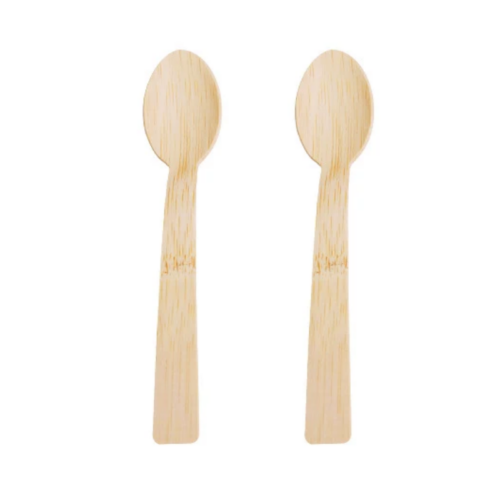
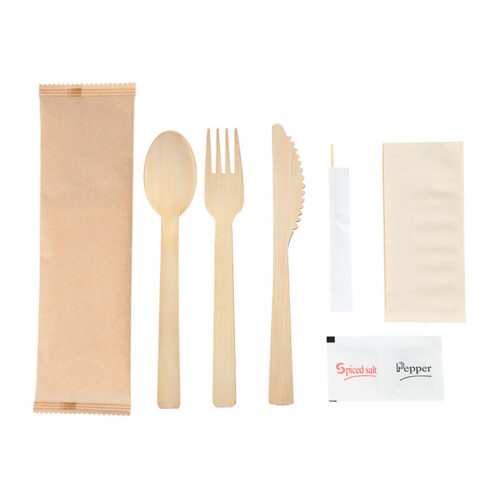
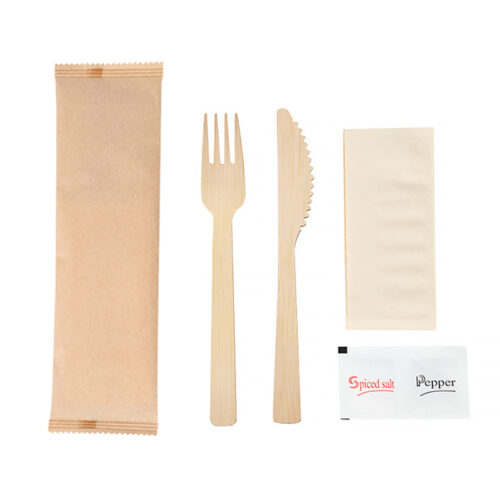
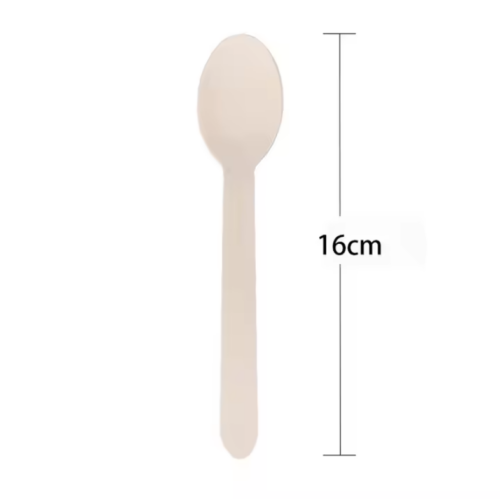
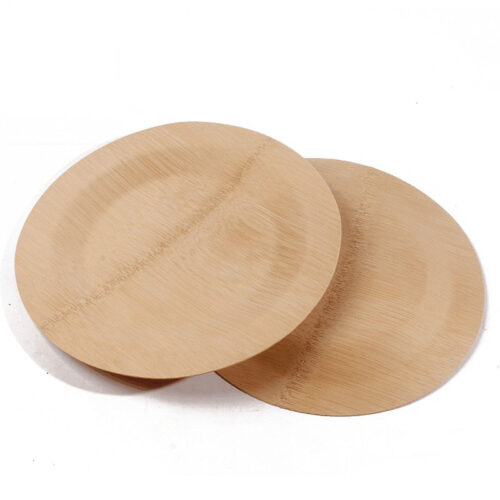
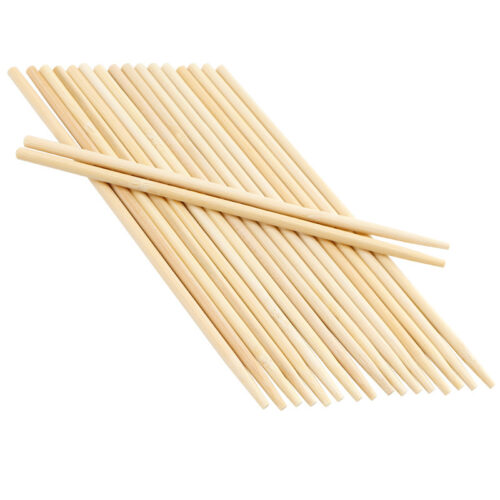
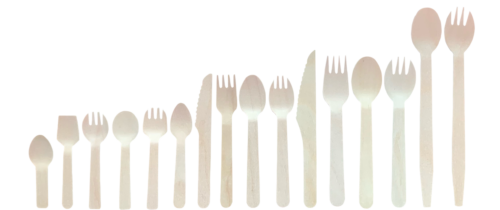
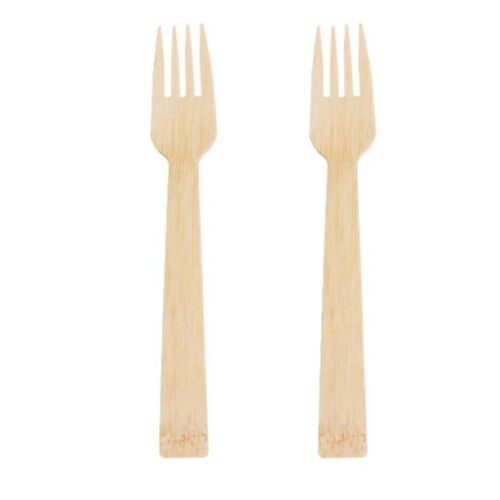
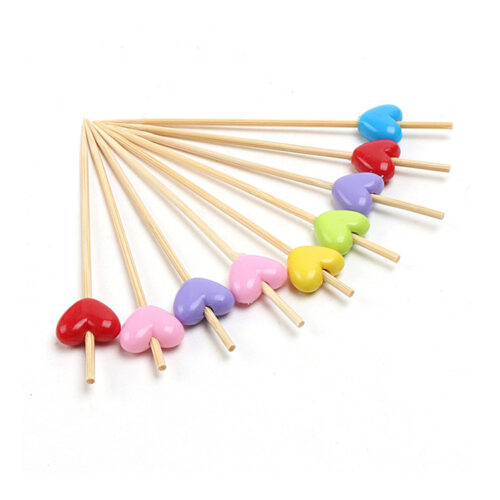
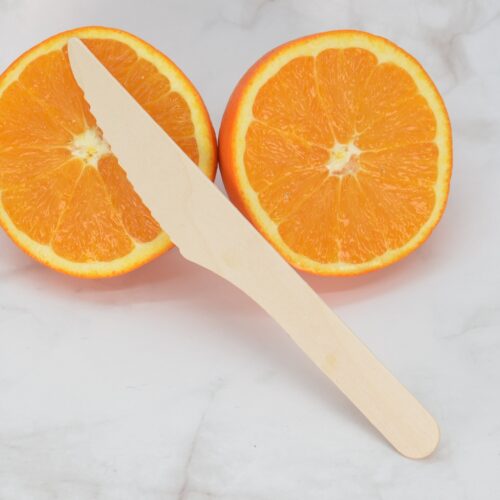
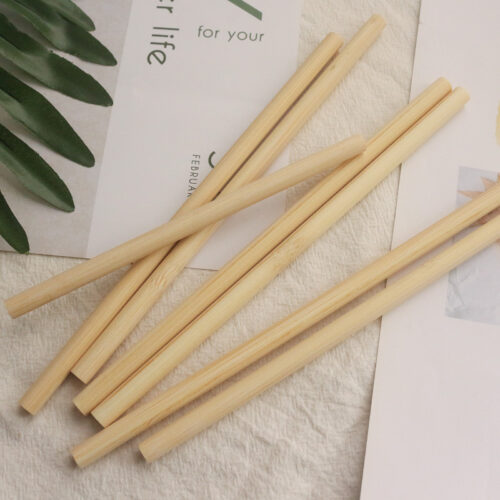
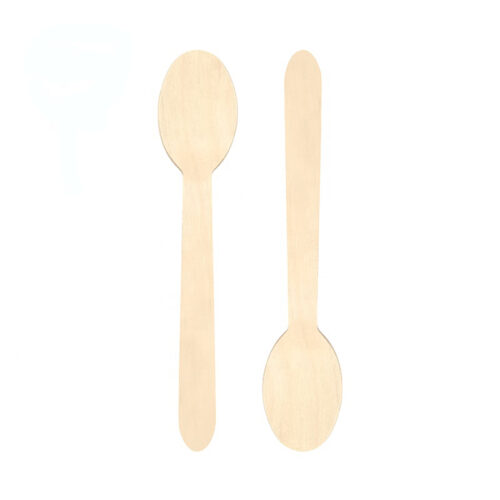
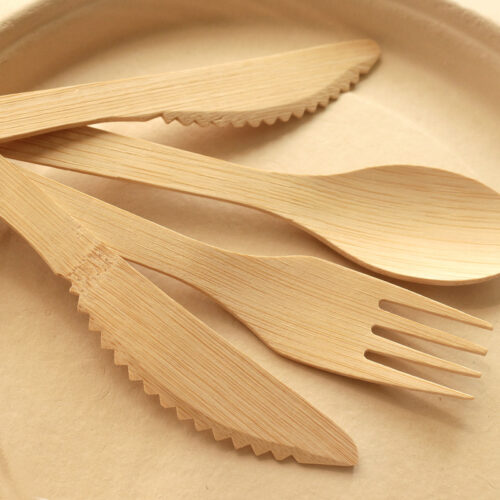
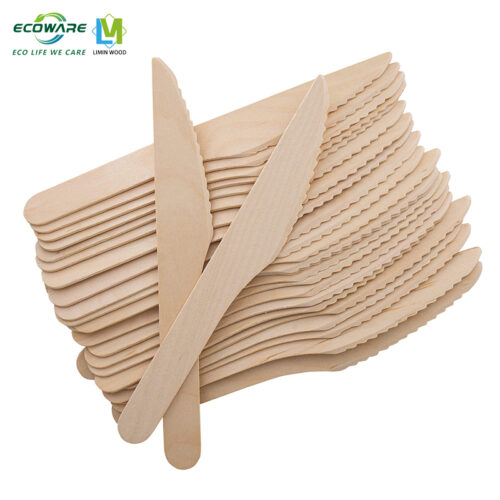
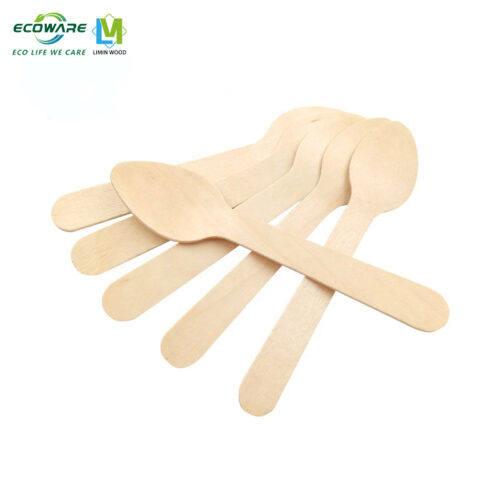
Ecoware does not make bamboo-melamine tableware. Our bamboo range includes single-use cutlery, chopsticks, skewers and stirrers. If you are comparing materials for foodservice, browse our disposable bamboo cutlery and ask for the material declaration for the exact item you are quoting, including whether any adhesive or coating is used. You can request a quote with that question attached. For the difference between bamboo and wood as materials, see wooden vs bamboo cutlery.
How this guide was made: drafted with AI assistance and edited by Ecoware’s marketing team on 1 October 2026. Regulatory and test statements come from the EU Commission, BfR, Food Standards Scotland, FSAI, FDA and the cited study, each linked where it is used. No product testing was carried out for this article. The illustration is generated.