Updated 30 September 2026. Prepared by Ecoware’s marketing team. Registers and regulations are linked to the issuing body or the official text where one is public, and were opened on the date above.
Short answer: The certifications for disposable cutlery suppliers, and the test reports that travel with them, fall into five kinds, and they prove different things. Chain-of-custody certificates (FSC, PEFC) prove the wood’s claim can be passed along the supply chain. Site certifications (BRCGS Packaging Materials, ISO 9001) prove a management system was audited at the sites listed on the certificate. Social audits (amfori BSCI, SMETA) report on working conditions; amfori BSCI gives an A–E rating, while SMETA lists non-compliances without an overall grade. Product certifications (BPI, TÜV Austria OK compost) prove a specific product passed compostability tests. Food-contact test reports (against US FDA rules, EU Regulation (EC) No 1935/2004, or German LFGB requirements) show a sample met a regulation’s limits on a date. FDA is a US agency and LFGB is a German law; neither issues a certificate for cutlery. Each kind has its own place to verify it, listed in the table below.
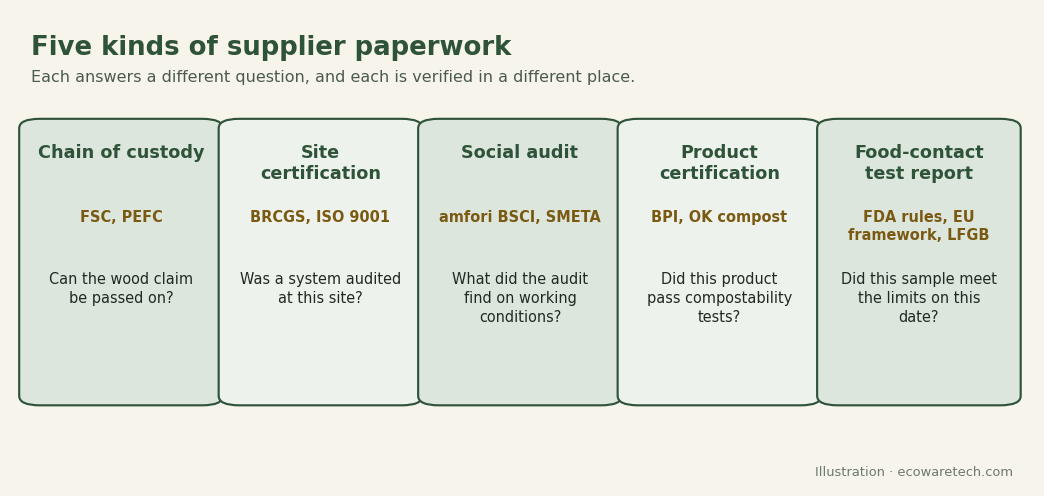
Illustration: the five kinds of supplier paperwork and the question each one answers. Drawn for this guide.
The certificate matrix
| Document | Kind | What it proves | What it does not prove | Where to verify |
|---|---|---|---|---|
| FSC chain of custody | Chain of custody | The holder can sell products with an FSC claim for the product groups in its scope | That a specific shipment is FSC unless the invoice carries the claim (FSC 100%, FSC Mix x% or FSC Recycled) and the certificate code; food safety; EUDR compliance | FSC public certificate search |
| PEFC chain of custody | Chain of custody | Same logic as FSC, under the PEFC scheme | Same limits as FSC | PEFC find certified |
| BRCGS Packaging Materials | Site certification | A food-safety and quality system for packaging manufacture, audited at one site and graded | That every product from that site meets your spec | BRCGS Directory |
| ISO 9001 | Site certification | A quality management system was audited against the standard at the sites listed | Anything about food contact or product performance | IAF CertSearch; not every certification body uploads there, so ask the certification body if a certificate is missing. ISO 9001:2026 was published in September 2026. Certificates to the 2015 edition stay valid during the transition; confirm the end date with your certification body |
| amfori BSCI | Social audit | Working conditions audited and rated | Product quality or safety | Audit reference and rating from the supplier; amfori members see results on the platform |
| SMETA | Social audit | An ethical-trade audit using the Sedex methodology; it is not a certification and gives no overall grade | Product quality or safety | Audit report shared through Sedex |
| EN 13432 test report | Test standard, not a certificate | A material passed EU industrial-composting tests (disintegration, biodegradation, ecotoxicity, heavy metals) | Home compostability; any right to use a compostable logo | Only through the OK compost or Seedling certificate it supports; ask for the certificate, not the report |
| BPI certified compostable | Product certification | That product passed commercial composting tests to ASTM D6400 or D6868 (BPI has also offered home certification since September 2025; check the listing) | Food-contact safety; that local composters accept it | BPI product catalogue |
| TÜV Austria OK compost INDUSTRIAL or HOME | Product certification | That product passed compostability testing under the scheme | Food-contact safety; acceptance in North American programmes | TÜV Austria database of certified products |
| FDA food-contact test report | Test report | A sample met the limits of the named FDA regulation on the test date | That FDA reviewed or approved the supplier; later batches | Lab name, method, sample description, date |
| EU or LFGB food-contact test report | Test report | A sample met EU or German requirements for the tests listed | Other materials in the same set (paper wrap, plastic window) | Lab name, method, sample description, date |
Three mistakes that show up on certification lists
On 30 September 2026, Bing’s Copilot answer for certifications for disposable cutlery suppliers listed CE marking, EU Regulation 10/2011 and “FDA” among them, and supplier decks often repeat the same list. Three of those items need correcting.
“FDA certified” or “FDA approved.” FDA’s own guidance says the agency does not approve manufacturing facilities independently. Food-contact substances are cleared through FDA regulations or notifications, not through approval of a supplier. What a supplier can show is a test report demonstrating that its material or coating meets the relevant FDA food-contact regulations, which sit in Title 21 of the Code of Federal Regulations. There is no FDA regulation written specifically for plain wooden cutlery, so a useful report names the sections for any coating, wax or adhesive on the piece, for example 21 CFR 175.300 for resinous and polymeric coatings or 21 CFR 175.105 for adhesives. 21 CFR 178.3800, sometimes quoted on wooden-cutlery spec sheets, covers wood preservatives on articles used to pack, transport or hold raw agricultural products, such as crates and bins, not eating utensils. Ask which sections the report covers and what sample was tested.
CE marking for cutlery. The European Commission states that not all products must have CE marking: “It is compulsory only for most of the products covered by the New Approach Directives.” Food-contact materials are governed by Regulation (EC) No 1935/2004, which has its own food-contact symbol (not required on items obviously meant for food, such as cutlery) and, where a specific EU measure exists, a written declaration of compliance. A CE mark on a wooden fork is not evidence of food-contact compliance.
EU 10/2011 for wooden cutlery. Regulation (EU) No 10/2011 is the EU’s specific measure for plastic food-contact materials. It matters for the plastic parts of an order, such as a plastic-film wrap or a plastic cutlery item in a mixed set, but plain wood is not a plastic. The European Commission’s food-contact legislation page lists which materials have specific EU measures; for materials without one, the general safety rules of the framework regulation apply, and some member states add national rules. When a supplier sends a 10/2011 report for a birch fork, ask what sample was actually tested.
Which paperwork a buyer is likely to ask for
This depends on the buyer’s market and channel more than on the material. Use the rows as a starting checklist and confirm with your customer or importer.
| If you sell into… | Expect to be asked for | Why |
|---|---|---|
| EU importers and wholesalers | A food-contact declaration or test report under the EU framework, national test results where the member state has rules, and EUDR due diligence data for wooden products | Framework safety rules apply to all materials, and HS heading 4419 is in scope of the EU Deforestation Regulation; see EUDR due diligence for wooden tableware |
| German retail and brands | LFGB test report | Germany’s Food and Feed Code (LFGB) is the legal basis. The BfR recommendations on food-contact materials cover coatings, waxes, paper and plastics but include no recommendation for wood, so ask the lab which tests it ran on the wood itself; for untreated wood these often include a sensory test for odour and taste transfer |
| US foodservice distributors | Food-contact test report against the relevant FDA rules; PFAS declarations for paper wraps in states that restrict them | See US state PFAS rules for foodware |
| Any channel making a “compostable” claim | BPI for the US and Canada; OK compost INDUSTRIAL or another certificate based on EN 13432 for Europe | See compostable certification by market |
| Retailers and brands with supplier codes | BRCGS Packaging Materials, a social audit (amfori BSCI or SMETA), and FSC or PEFC for any sustainable-wood claim | Their supplier codes of conduct usually name these documents; ask for the buyer’s own list |
| EU, paper packaging with the cutlery | PFHxA compliance for paper and board | See the EU PFHxA restriction for food-contact paper |
One document that often causes confusion does not belong on this list at all: the ISPM 15 stamp is for wooden pallets and crates, not for cutlery. See ISPM 15 and wooden tableware exports.
A five-minute check for any certificate you receive
- Match the legal entity. The name and address on the certificate should match the manufacturer, or the invoice should show how the two companies are related.
- Look it up on the issuer’s register, using the links in the matrix. A certificate that does not appear, or appears as suspended or expired, does not cover your order.
- Read the scope. For FSC and PEFC, check that cutlery or wooden tableware is in the product groups. For BRCGS and ISO 9001, check that the scope wording covers the product you are buying.
- For product certificates, match the product. A BPI or OK compost listing names specific products or materials. A certificate for a paper cup does not cover a birch fork.
- For test reports, match the sample. The report should describe your material and any coating, name the lab and the method, and be recent enough for your customer’s rules.
Where this fits in supplier vetting
Certificates are one of four checks in our guide to how to choose a wooden cutlery manufacturer in China, alongside confirming the factory, getting MOQ and lead time in writing, and agreeing inspection before payment.
Hold Ecoware to the same checks as any other supplier on your list. Our factory page describes the plant; ask us for the certificate numbers and food-contact reports for the SKU you are quoting, and check them on the registers above before you place the order.
Statements about what each scheme covers come from the issuing body’s own pages, linked in the matrix and checked on 30 September 2026. This is general guidance, not legal advice; confirm requirements with your importer or regulator.
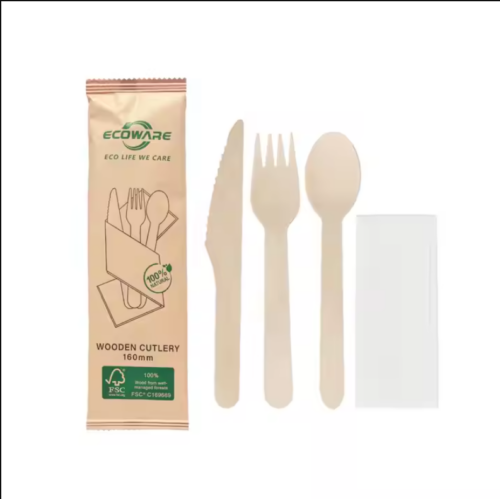
Products in this guide
Related buyer guides
- Pre-Shipment Inspection Checklist for Wooden Cutlery from China: Defects, AQL Sampling and What to Reject
- Trading Company vs Manufacturer: How to Tell Who You’re Really Buying Cutlery From
- Bamboo Cutlery Sustainability: The B2B Buyer’s Risk & Cost Analysis
- EU PPWR & SUP 2026: Disposable Cutlery Compliance Guide | Ecoware