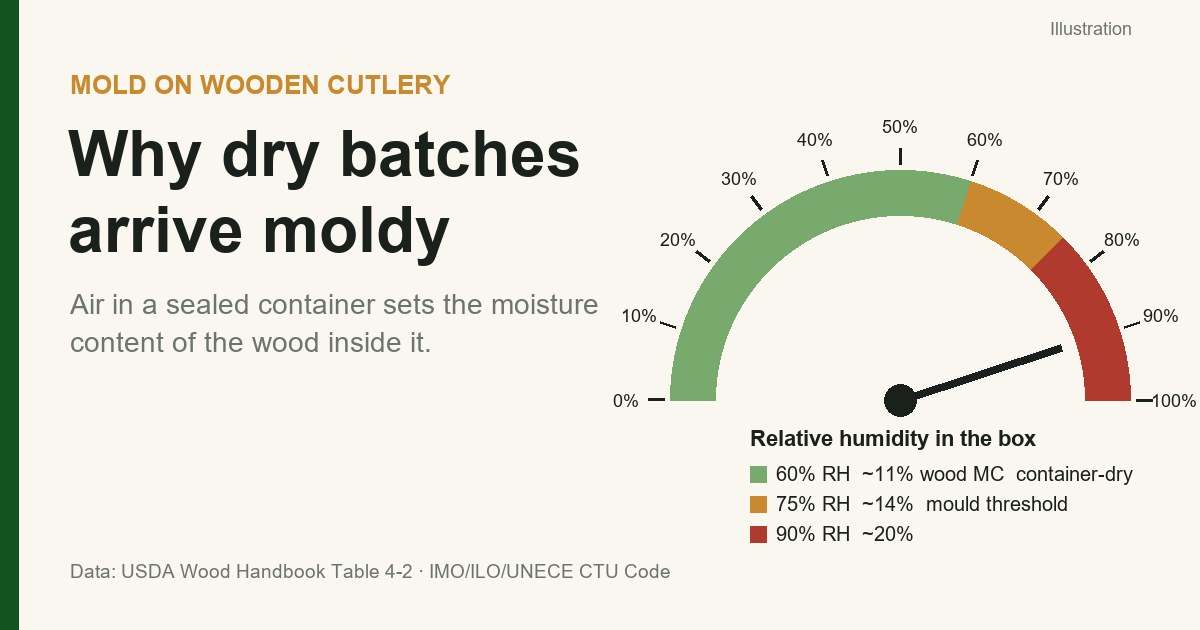
Mold on disposable wooden cutlery is a moisture problem, and it can begin after the goods have passed inspection. Wood held at or below about 20% moisture content has what the USDA Forest Products Laboratory calls a reasonable margin against fungal damage. Leave that same wood in air at 90% relative humidity and it settles back to roughly 20%, and the air inside a closed container swings with the daily temperature cycle, condensing under the roof when it cools. The international code of practice for packing containers asks for drier goods than 20%: applied to the handbook’s own table, its target works out to about 11% moisture content for wood. The controls that decide the outcome are the moisture content at packing, the dryness of the cartons and pallets it travels with, barrier packing on humid routes, and a check on arrival. Moldy single-use items are rejected, not cleaned.
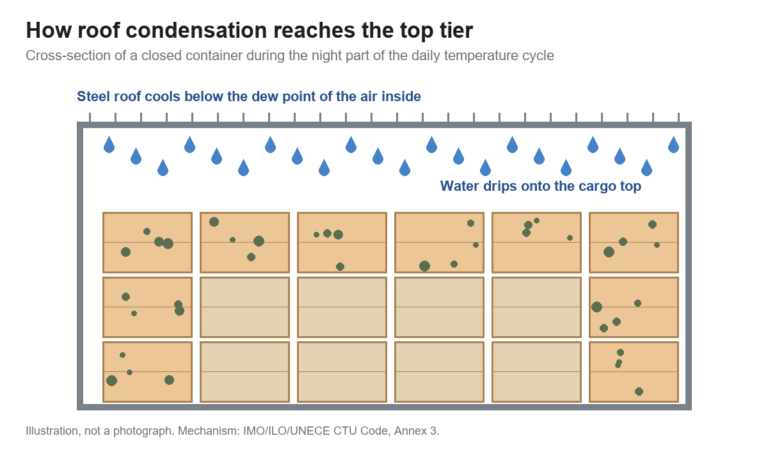
Illustration, not a photograph: how roof condensation reaches the top tier of a load.
Why cutlery that left the factory dry can arrive moldy
Wood is hygroscopic. It takes up or gives off water until it matches the air around it, and the USDA Forest Products Laboratory Wood Handbook, Chapter 4 names that end point the equilibrium moisture content (EMC): “that moisture content at which the wood is neither gaining nor losing moisture.” A batch dried at the factory is only dry in relation to the air it sits in next.
The same handbook’s chapter on biodeterioration separates two thresholds. Serious decay needs moisture above the fiber saturation point, which averages 30%, and dried wood normally only gets there through liquid water such as rain, condensation or wet ground. Mold asks for less: humid air “will not wet wood sufficiently to support significant decay, but it will permit development of some mold fungi.” Fully air-dried wood, the chapter adds, “usually will have a moisture content not exceeding 20% and should provide a reasonable margin of safety against fungal damage.”
So a lot can measure dry at loading and still show spots after weeks at sea, because the air it traveled in put the moisture back.
What “dry enough to ship” means in numbers
Two published sources can be put side by side to turn “keep it dry” into a number.
The CTU Code, the IMO/ILO/UNECE code of practice for packing cargo transport units, says in Annex 3 that cargoes of organic origin, “including … wood and wood products”, should be packed “container-dry”. It sets the mould growth threshold at 75% relative humidity and defines container-dry as a moisture content that stays in equilibrium with about 60% relative humidity inside the container, leaving a margin for daily temperature swings.
The Wood Handbook‘s Table 4-2 gives the moisture content wood settles at for each humidity level:
| Relative humidity of the air | EMC at 21.1 °C (70 °F) | EMC at 26.7 °C (80 °F) | EMC at 32.2 °C (90 °F) | What the humidity level marks |
|---|---|---|---|---|
| 60% | 11.0% | 10.8% | 10.5% | CTU Code “container-dry” condition |
| 70% | 13.1% | 12.9% | 12.6% | |
| 75% | 14.4% | 14.2% | 13.9% | CTU Code mould growth threshold |
| 80% | 16.0% | 15.7% | 15.4% | |
| 85% | 17.9% | 17.7% | 17.3% | |
| 90% | 20.5% | 20.2% | 19.8% | Wood reaches the Wood Handbook‘s 20% margin |
| 95% | 23.9% | 23.6% | 23.3% |
Source: USDA Forest Products Laboratory, Wood Handbook (FPL-GTR-282), Chapter 4, Table 4-2. Values are generic for wood, not measured on any particular cutlery species.
Reading the two together: container-dry wood sits at about 11% moisture content between 21 °C and 32 °C, and the CTU Code’s mould threshold corresponds to about 14%. Neither source prints that cross-walk; it comes from applying the code’s humidity figures to the handbook’s table, and the inputs are all above. The 20% figure buyers often quote is the handbook’s margin for air-dried wood in general. For a sealed box on a long voyage, the shipping code asks for noticeably drier goods.
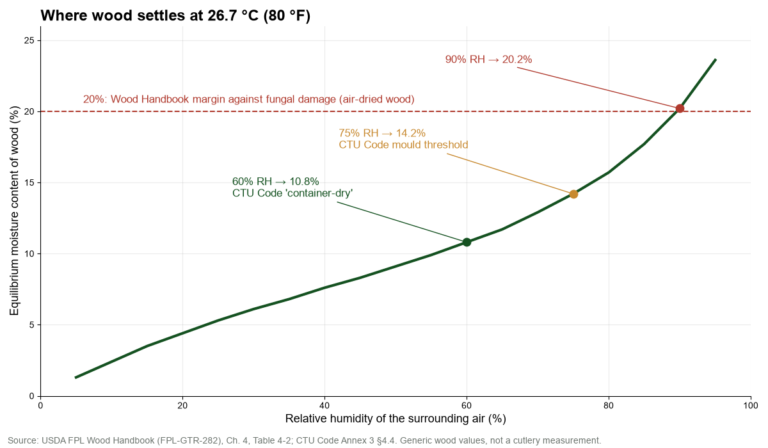
Chart re-plotted from Wood Handbook Table 4-2 (26.7 °C column).
The table shows the direction the wood is moving, not the speed. How fast a given utensil gets there depends on its size, finish and packing, and there is no published rate for disposable cutlery to cite here.
Where the moisture comes from inside a container
Annex 3 of the CTU Code describes three ways moisture reaches wooden goods inside a sealed container.
The first is container sweat. Daily temperature swings cool the steel roof and walls. When air touching them drops below its dew point, which the German Insurance Association’s Transport Information Service defines as the limit below which cooled air forms condensation, water collects under the roof and falls onto the cargo top. The code recommends covering very sensitive cargo with fleece “against falling drops of sweat water”.
The second is cargo sweat. Goods shipped from a cold climate into a warm, humid one can draw condensation from the air when the container is opened. The code’s advice is to delay unpacking until the goods have warmed, unless they are sealed in vapour-tight sheeting with desiccant.
The third is the packing itself. The code estimates the moisture content of “dry” dunnage, pallets and packing material at 12% to 15%, and states that at that level “the relative humidity of the air inside the CTU will inevitably establish itself at about 60% to 75% after closing the doors.” Before the cargo adds any moisture of its own, the air in the box is already close to the mould threshold.
Humidity also works on the cartons. The code notes that as humidity rises from 40% to 95%, ordinary cardboard “loses up to 75% of its stableness”, which is how damp voyages end in collapsed stacks.
Where mold starts: a stage-by-stage check
Where the mold shows up on arrival is the best clue to where it started. The table below links the pattern you find to the stage that most likely caused it and to the control that addresses it. Treat the middle column as a pattern to investigate, not as proof.
| Stage | What goes wrong | What it tends to look like on arrival | Control to specify |
|---|---|---|---|
| Drying at the factory | Goods packed before reaching the agreed moisture content | Spots spread evenly through cartons, including the centre of bundles | Maximum moisture content at packing, with the test method |
| Storage before packing | Dried stock takes moisture back in a humid warehouse, following the table above | Similar to the row above; loading records tell them apart | Reading taken on the day of packing, not the day of drying |
| Packing materials | Cartons, inner boxes and pallets bring their own 12% to 15% moisture into the box | Soft or damp cartons, musty smell on opening | Dry, new cartons; dry pallets and dunnage |
| The voyage | Container sweat drips from the roof onto the cargo top | Mold concentrated in the top tier and in cartons against walls or doors; water marks on outer cartons | Sealed inner bags on humid routes, fleece or cover sheet on the top tier, container checked dry before loading |
| Unpacking and storage | Cargo sweat when cold goods meet warm, humid air; cartons stored on damp floors | Condensation on cartons after opening; mold appearing weeks after receipt | Timed unpacking; storage as the FDA Food Code requires for single-service articles |
What desiccants can and cannot do
The CTU Code supports desiccant pouches for a defined job. When packing materials bring moisture into the box, it recommends “active drying of the dunnage and packing material or the use of desiccants … in combination with a sealed plastic wrapping.”
It is just as direct about their limit: “The introduction of desiccants into a CTU containing hygroscopic cargo, that is not ‘container-dry’, will generally fail due to the lack of sufficient absorption capacity of the drying agent.”
For wooden cutlery, desiccant protects a dry load from the humidity a voyage adds, and it does not rescue a load that went in damp. A purchase order that asks for desiccant but says nothing about moisture content at packing is relying on a control that only works when the other one is already in place.
Moisture terms to write into the purchase order
These terms give a supplier something to sign and an inspector something to check:
- Write the maximum moisture content at packing as a number. The calculation above points to about 11% for container-dry wood and about 14% at the mould threshold; the Wood Handbook‘s 20% is a general margin, not a shipping target. Agree the figure with your supplier in writing. This guide does not state one for any particular product.
- Name the method behind the number. ASTM D4442 covers direct measurement of wood moisture content; ASTM describes its oven-dry Method A as the primary method, which makes it the one to name if a reading is disputed. Hand-held meters are faster for routine checks; ASTM D4444 covers their laboratory standardization and calibration. State which one decides acceptance.
- Require the reading on the day of packing, on units taken from finished cartons rather than from the drying line.
- Ask for a photo of the meter reading next to the batch or carton marking, sent before the container is closed.
- Specify new, dry cartons, and pallets or dunnage kept dry. Any wood packaging must also carry the pest-treatment mark under ISPM 15, which is about pests, not moisture, so it does not replace the moisture terms. Our ISPM 15 guide covers what it applies to.
- On humid routes, add sealed inner bags with desiccant as a supplement to term 1, and a cover sheet over the top tier.
- Require a container that is clean, dry and free of roof leaks before loading.
- Set out what happens if mold is found: the inspection window after arrival, the evidence you will provide, and the remedy.
Checking a shipment on arrival
- Before unloading, look at the underside of the roof and the walls for condensation or water marks.
- Open cartons from the top tier and from positions against the walls and doors first. That is where roof condensation lands.
- Check for a musty smell, surface spots and discoloration.
- Take moisture readings with the method named in the PO, on the cartons you opened.
- Photograph carton marks, spots and readings together, and set affected cartons aside.
- Decide the scope from where the mold is. If spots run through cartons from the middle of the load and through the centre of bundles, the stage table above points to moisture that was there at packing, so treat the whole lot as suspect and measure widely before accepting any of it. If they are confined to the top tier and the cartons against the walls or doors, the pattern points to condensation during the voyage, so isolate those cartons and measure the rest before releasing them.
- If cold goods have arrived in warm, humid weather, follow the CTU Code and hold off unpacking until they have warmed, unless they are sealed with desiccant.
- Store accepted stock the way the FDA Food Code 2022 requires for single-service articles in §4-903.11: in a clean, dry location, at least 15 cm (6 inches) above the floor, in the original protective package.
The same visual checks sit alongside splinter and odor checks in our acceptance checklist for wooden cutlery.
Can moldy disposable cutlery be cleaned and used?
No. The FDA Food Code 2022 states in §4-502.13 that single-service and single-use articles “may not be reused”, so washing is not an option for disposable cutlery in a food establishment. The EPA’s mold cleanup guidance explains why porous items are poor candidates anyway: absorbent or porous materials “may have to be thrown away if they become moldy”, because mold “can grow on or fill in the empty spaces and crevices.” Reject the affected cartons, document them for the claim, and check the rest of the lot.
Advice about cleaning a moldy wooden spoon at home concerns a reusable kitchen tool, not a carton of single-use cutlery, and does not carry over.
If you are writing a moisture clause into your next wooden cutlery order, send the draft terms and your destination port through our quote form, and we will reply with which of them we can commit to in writing.
For the full inspection routine, including how the sample is drawn and when to reject a lot, see our pre-shipment inspection checklist for wooden cutlery.
The EMC chart re-plots published Wood Handbook data; the container diagram is an illustration. Neither reports a measurement on Ecoware’s own products. Published 24 September 2026.