Updated 30 September 2026. Prepared by Ecoware’s marketing team. Sample sizes and accept/reject numbers follow the single-sampling, normal-inspection tables of ISO 2859-1 (sample-size code letters, and Table 2-A as numbered in the 1999 edition). The standard was reissued as ISO 2859-1:2026, so name the edition in your PO.
Short answer: A pre-shipment inspection checklist for wooden cutlery covers five things on a random sample of the finished, packed goods: defects on the pieces (mould, splinters, cracks, broken tines, wrong dimensions), moisture content, counts and packing, labels and marks, and the condition of the cartons and the container. The sample size and the number of defects you tolerate come from the sampling plan you named in the purchase order, usually ISO 2859-1 at General Inspection Level II with an AQL for major and minor defects and zero tolerance for critical ones. One decision is easy to leave out: defining what one “unit” is, whether a piece, an inner bag or a carton. That single choice changes the sample size more than the AQL does.
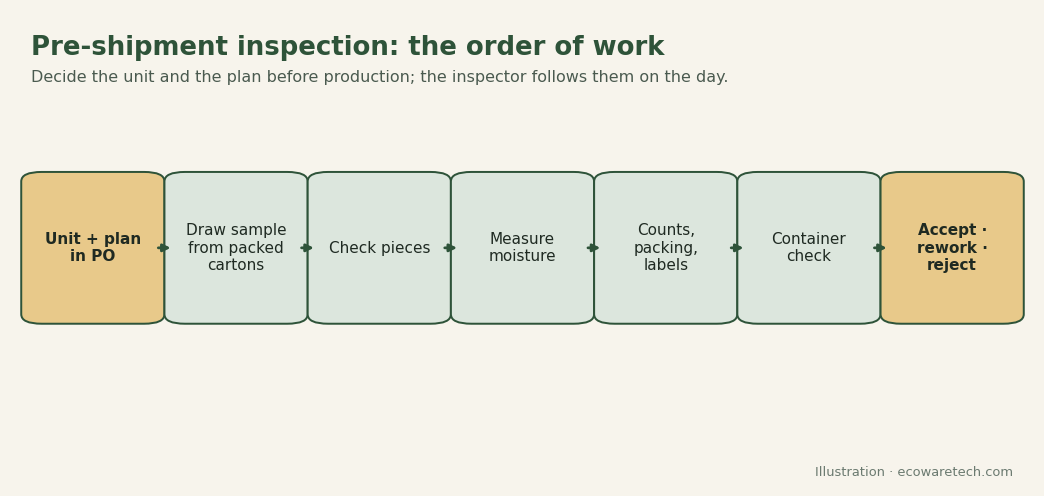
Illustration: the order an inspector works through on the day. Drawn for this guide.
Before the inspection: three decisions to put in the PO
An inspector can only enforce what the purchase order says. Agree these in writing before production starts:
- The unit of inspection. For cutlery packed 100 pieces to a bag, is a “unit” one piece or one bag? If the unit is the bag, one defective piece can make the whole bag defective, or the PO can say how many defective pieces a bag may contain.
- The sampling plan. For example: ISO 2859-1, single sampling, normal inspection, General Inspection Level II; critical defects 0 accepted; major defects AQL 2.5; minor defects AQL 4.0.
- The defect list. Which defects are critical, major and minor for this product (a template follows). Without it, “splinter” and “natural grain” get argued on the factory floor.
Also agree timing: many inspection companies ask for production to be finished and at least 80% of the order packed, so the sample can be drawn from sealed cartons.
One technical note on the plan: ISO 2859-1 is designed for a continuing series of lots, with rules for switching between normal, tightened and reduced inspection. For a one-off order, ISO 2859-2:2020 covers isolated lots; its plans are chosen by limiting quality (LQ), not AQL, so a PO that uses it must state an LQ value. Many inspection companies apply 2859-1 normal inspection to single orders anyway, so state which you want in the PO. For the wider supplier-selection context, see our guide to how to vet a wooden cutlery manufacturer in China.
How big the sample is: the unit matters more than the AQL
Under ISO 2859-1 at General Inspection Level II, the lot size sets a code letter, and the code letter sets the sample size. For the lot sizes cutlery orders usually fall into:
| Lot size (units) | Code letter | Sample size | Accept / reject at AQL 2.5 | Accept / reject at AQL 4.0 |
|---|---|---|---|---|
| 1,201 – 3,200 | K | 125 | 7 / 8 | 10 / 11 |
| 3,201 – 10,000 | L | 200 | 10 / 11 | 14 / 15 |
| 10,001 – 35,000 | M | 315 | 14 / 15 | 21 / 22 |
| 35,001 – 150,000 | N | 500 | 21 / 22 | Arrow up: use code M (315 units, 21 / 22) |
| 150,001 – 500,000 | P | 800 | Arrow up: use code N (500 units, 21 / 22) | Arrow up: use code M (315 units, 21 / 22) |
Now apply that to a real order. Take 600,000 wooden forks packed 100 to an inner bag:
| If the unit is… | Lot size | Code letter | Sample |
|---|---|---|---|
| One fork | 600,000 pieces | Q (500,001 and over) | At AQL 2.5 the arrow points to code N: 500 pieces, accept 21, reject 22. At AQL 4.0 it points to code M: 315 pieces, accept 21, reject 22. Many inspection companies draw the larger sample (500) and apply accept 21 / reject 22 to both classes. That is stricter than the plan for minor defects, which strictly needs only 315 pieces, so say which you want in the booking |
| One inner bag of 100 | 6,000 bags | L | 200 bags, each opened and checked |
Checking 200 bags of 100 means looking at 20,000 forks, which at a few seconds per fork is well over a day of checking for one inspector. It is also a much stricter test. If one bad fork makes a bag defective, a lot in which only 0.1% of forks are bad has about 9.5% defective bags (1 − 0.999¹⁰⁰, assuming bad forks are spread at random across bags), or roughly 19 in a sample of 200, well over the AQL 2.5 reject number of 11. If the bag is your unit, either allow a set number of defective pieces per bag, or express the AQL as nonconformities per 100 items and check a fixed number of pieces from each sampled bag. Alternatively, keep the piece as the unit and draw the 500 pieces from at least 50 different bags. Whichever unit you choose, write it into the PO and the inspection booking so the inspector and the factory use the same one.
When the sampling table shows an arrow instead of a number, the standard sends you to the nearest plan in the direction of the arrow. Ask for the resulting plan to be stated in the inspection report.
Defect classification template for wooden cutlery
Classification is the buyer’s decision. Adapt this template to your product and market:
| Class | Typical defects on wooden cutlery | Common tolerance |
|---|---|---|
| Critical | Visible mould or mildew; insects or foreign matter in the bag; a fragment that can break off in the mouth; any odour of chemicals or smoke | Zero accepted: one found fails the lot |
| Major | Raised splinters or feathered edges that snag a fingertip; cracks through the piece; missing or broken tines; dimensions or thickness outside the PO tolerance; moisture above the PO maximum; wrong count per bag | AQL agreed in the PO, often 2.5 |
| Minor | Colour variation within the species; small tight knots that do not weaken the piece; light surface marks; small print misregistration on sleeves | AQL agreed in the PO, often 4.0 |
For the finish itself, our splinter-free wooden cutlery checklist gives purchase-order wording that separates a defect from ordinary grain.
The checklist
1. Pieces (on every sampled unit)
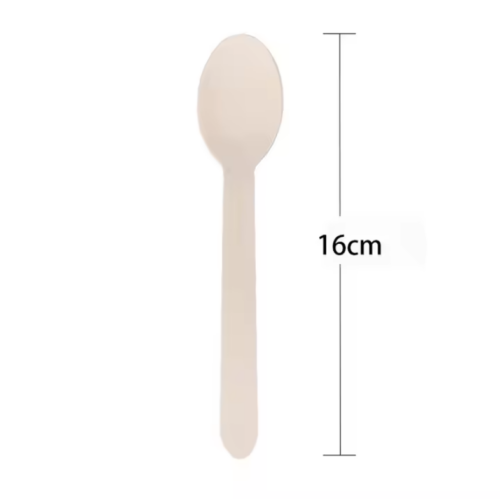
- Shape, length and thickness against the approved sample and the PO drawing; measure at least a few pieces per unit with a calliper.
- Surface: run a fingertip along edges, tines and the bowl of spoons; note any snag, fuzz or raised fibre.
- Cracks, splits and broken tines, including hairline cracks at the neck of forks and spoons.
- Mould spots, dark staining and any musty smell when the bag is opened.
- Foreign matter inside the bag: sawdust, insects, hair, fragments.
- Function check on a few pieces: bend a fork gently, cut a soft food item with a knife, as agreed in the PO.
2. Moisture content
Moisture at packing is what decides whether mould appears weeks later in a container. Measure it on the day:
- Use a pin or pinless meter set to birch (or the agreed species), with temperature correction, and ask for its calibration record; ASTM D4444 is the laboratory method behind that calibration.
- If a result is disputed, the reference is oven-dry measurement under ASTM D4442, which a lab can run on retained pieces.
- Take at least 10 readings from pieces drawn from at least 5 different cartons, and record each one.
- Compare with the maximum moisture content written in the PO. Our guide to mould on wooden cutlery works out a target of about 11% moisture content for wood in a sealed container, and explains why the Wood Handbook’s general 20% margin is too loose for a sealed container on a long voyage.
3. Counts and packing
- Pieces per inner bag, bags per carton, cartons per pallet, against the packing list.
- Bag sealing, and that each bag is clean and dry inside.
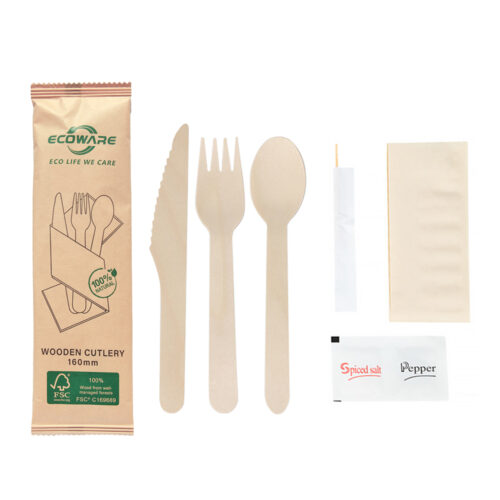
- Carton dimensions and gross weight against the packing list. As a reference for the kind of figures to expect, Ecoware packs cutlery sets at 500 sets per carton in a 41 × 22 × 39 cm or 50 × 21 × 34 cm carton (4 to 7 kg) and loose single pieces at 1,000 to 5,000 per carton (about 50 × 35 × 25 cm, 5 to 10 kg).
- Carton strength: corners, seams, no crushing or damp patches.
- Desiccants or liners if the PO requires them.
4. Labels, marks and documents
- Carton shipping marks, SKU, batch or production date, and any barcode, checked against the PO artwork.
- Printed sleeves or retail packs: artwork version, spelling, recycling or compostability marks. Any “compostable” wording must match a certificate you hold; see compostable certification by market.
- For FSC-claimed goods, the FSC claim and certificate code on the documents. Our guide to certifications for disposable cutlery suppliers explains how to check the code.
5. Container and loading, if you book a loading check
- Container interior dry, clean and free of odour and holes; photograph the floor, walls and roof.
- Pallets or crates carry the ISPM 15 heat-treatment mark where the destination requires it; the cutlery itself does not need one. See ISPM 15 and wooden tableware.
- Carton count loaded matches the packing list; seal number recorded.
Accept, rework or reject?
| Result | What it usually means | What to do |
|---|---|---|
| All classes within the plan | Lot accepted | Release balance payment as the contract says; keep the report with the shipment file |
| Critical defect found | Lot fails regardless of numbers | Stop shipment; agree 100% sorting or replacement, then re-inspect |
| Major or minor above the reject number | Lot fails the plan | Agree sorting or rework of the affected units, then a re-inspection at the same plan; agree in advance who pays for it |
| Moisture above the PO maximum | High risk of mould in transit | Re-dry and repack, then re-measure; do not ship on the promise of a desiccant alone |
| Counts or labels wrong, pieces fine | Documentation or packing error | Correct and re-check the affected cartons |
What a usable inspection report contains
A report is useful in a dispute only if it records how the inspection was done. Check that yours includes: the sampling plan and unit of inspection; the lot size and sample size; the number of defects found in each class with photographs; moisture readings with the meter, species setting and location of each reading; carton and packing measurements; and the inspector’s name and date. If the report only says “passed”, ask for the numbers.
A real example of how a buyer’s audit team walks a wooden cutlery plant is in our factory inspection case.
If you are placing an order with Ecoware, tell us the sampling plan and the inspection company when you request a quote, and we will build the inspection date into the production schedule.
Confirm the exact sampling plan and the edition of ISO 2859-1 for your order with your inspection company. Carton figures come from Ecoware’s sales department.