Updated 30 September 2026. Prepared by Ecoware’s marketing team. Test conditions are quoted from the certifiers’ own pages; the California section is dated because the rule is still moving.
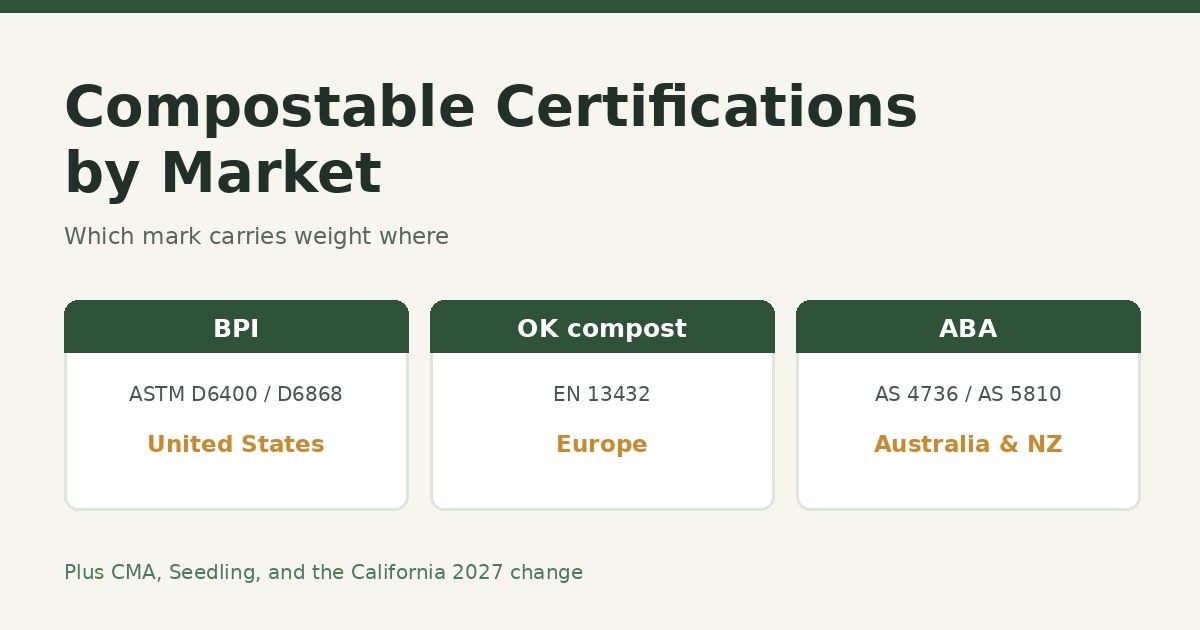
Short answer: There is no global compostable certification. Pick the mark by the market the product is sold in. BPI certifies products for the United States and Canada, tested against ASTM D6400 and related ASTM standards. TÜV Austria’s OK compost INDUSTRIAL and the Seedling logo are the common European marks, both built on EN 13432. Australia and New Zealand use ABA verification against AS 4736 and AS 5810. A home-compostable claim needs its own home-composting test or certification; an industrial certificate does not cover it. A certificate is also not the same as a permitted label: California, for one, is adding conditions to the word “compostable” on top of certification.
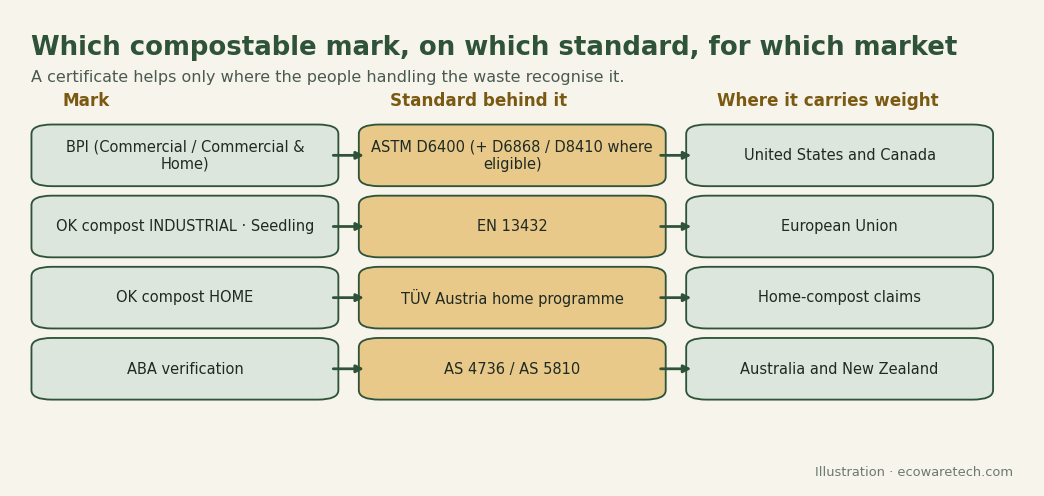
Illustration: which mark sits on which standard, and where it is recognised. Drawn for this guide from the table below.
Standard, certification and label are three different things
Most confusion about compostable claims comes from treating these as one thing:
- A standard is the test specification: EN 13432 in Europe, ASTM D6400 in the US. Nobody “holds” a standard.
- A certification is a third party confirming that a specific product or material passed the tests. BPI and TÜV Austria issue certifications, each with a number and a public listing.
- A label claim is what you print on the pack. Labelling laws and consumer-protection rules decide whether the claim is allowed, and they can add conditions beyond certification.
A supplier that says its cutlery “meets EN 13432” without a certificate number is naming a test standard; there is no certificate to check.
The marks, their standards, and where each carries weight
| Mark | Tested against | Where it carries weight | Where to verify |
|---|---|---|---|
| BPI Certified Compostable (“Commercial Only”) | ASTM D6400 as the base standard, with ASTM D6868 (plastic film or sheet attached to a substrate) or ASTM D8410 (cellulosic-fibre substrates, not fibre laminated with thermoplastic) where BPI’s reviewers find them eligible, per BPI | United States and Canada | BPI product catalogue |
| BPI “Commercial & Home” | BPI’s home scheme; commercial certification is a prerequisite | United States and Canada, home-compost claims only | BPI product catalogue |
| TÜV Austria OK compost INDUSTRIAL | EN 13432 | Europe, and used as a reference elsewhere | TÜV Austria database of certified products |
| TÜV Austria OK compost HOME | TÜV Austria’s home-composting programme | Europe and internationally, home-compost claims only | TÜV Austria database of certified products |
| Seedling logo | EN 13432, with certification by DIN CERTCO or TÜV Austria Belgium under the European Bioplastics Seedling scheme | Europe | Registration number on the product |
| CMA certification | ASTM or EN lab results plus field disintegration at operating facilities: over 80% for fibre, over 90% for biopolymers, per CMA’s requirements | United States, where a facility’s real-world acceptance is the question | CMA |
| CMA substrate review (CMA-S) | For uncoated, untreated fibre-based products: under 100 ppm total fluorine, food-safety documents where applicable, and a physical inspection; no field test. CMA says this acceptance is not a certification | United States | CMA-S listings |
| ABA verification | AS 4736 (commercial) and AS 5810 (home) | Australia and New Zealand | Australasian Bioplastics Association |
What the tests actually measure
Compostability certification under EN 13432 rests on four tests, as TÜV Austria sets them out: biodegradation (chemical breakdown), disintegration (physically falling apart into small fragments), ecotoxicity of the resulting compost, and limits on heavy metals and other regulated substances. The ASTM route covers the same ground.
The difference between commercial and home certification is temperature and time. BPI publishes both sets of conditions on its certification page:
| Test | Commercial certification | Home certification |
|---|---|---|
| Disintegration | 58 ± 2 °C, up to 84 days | 25 ± 2 °C, up to 180 days |
| Biodegradation | 58 ± 2 °C, 6 months | 25 ± 2 °C, 12 months |
A product certified only for commercial composting has not been shown to break down in a garden heap. Calling it home compostable is the kind of claim consumer-protection rules target; the US Federal Trade Commission’s Green Guides expect environmental claims to be qualified to what can be substantiated.
What certification looks like for untreated wood
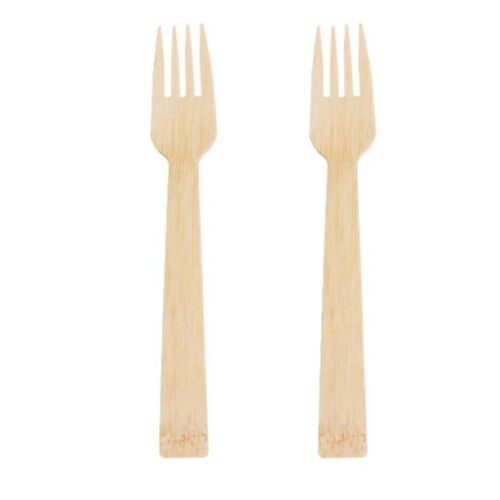
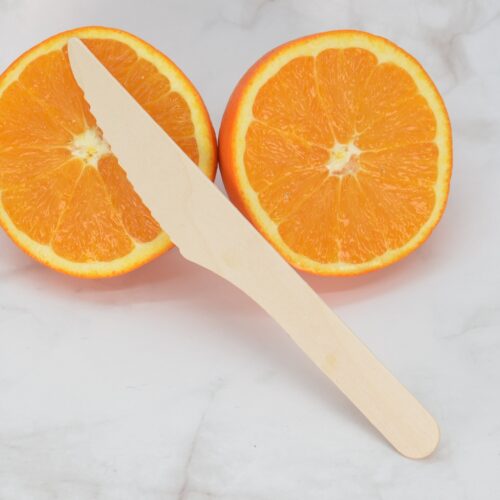
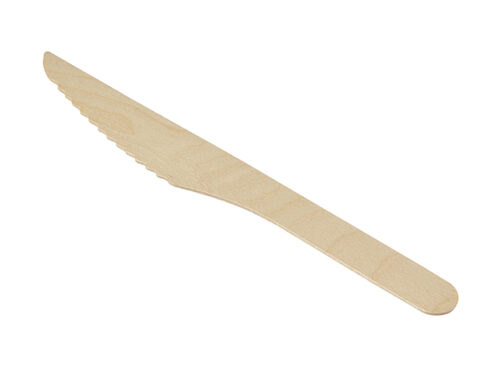
Under EN 13432, materials of natural origin that have not been chemically modified, such as wood, are deemed biodegradable by default, as TÜV Austria’s comparison of standards explains. The biodegradation test is not what decides a birch fork. What remains is chemical characterisation, ecotoxicity and disintegration: after 12 weeks, no more than 10% of the dry mass may remain on a 2 mm sieve. Because disintegration depends on shape, a certificate covers the thickness that was tested, and thinner versions of the same material are covered automatically. For a cutlery range, submit the thickest item, because the certificate then covers thinner pieces of the same material.
In the US, uncoated and untreated fibre products have a second route: CMA’s substrate review (CMA-S), listed in the matrix above. There is no field test; CMA checks total fluorine (under 100 ppm), food-contact documents and ink data if the item is printed, and inspects the product itself.
BPI or a European mark? Decide by where the product ends up
A certificate helps only if the people handling the waste recognise it. Three questions settle which one you need:
| Question | If the answer is… | Then |
|---|---|---|
| Where will the used cutlery be collected? | A US or Canadian commercial composter | Check whether the facility screens by the BPI catalogue; a European certificate based on EN 13432 will not appear there |
| An EU collection scheme | A certificate based on EN 13432, such as OK compost INDUSTRIAL or Seedling | |
| Home compost bins | A home certification in that market, not an industrial one | |
| Who is asking for the certificate? | A composting facility | The facility’s own acceptance list decides; ask it which marks it accepts |
| A retailer or brand specification | Meet or negotiate the mark named in the specification | |
| Your own marketing | Decide whether you need the word “compostable” on the pack at all (see the California section) | |
| Is the product sold in more than one region? | US and EU | Two certifications are common, one per region |
How to check a compostable certificate in five minutes
- Search the issuer’s list: the BPI product catalogue or the TÜV Austria database, by company name and product.
- Confirm the listing names the exact item, or a material that covers it, and the maximum thickness tested.
- Check the certificate holder is your supplier or its material maker, and that the certificate has not expired.
- For a US composter, ask which marks its gate accepts before you pay for any certification.
California: certification is not enough for the label
Since 1 January 2026, California’s AB 1201 has barred the word “compostable” on a product unless it is also allowed under the USDA National Organic Program as an input for organic production. CalRecycle’s letter to BPI of 11 June 2025 extended that date to 30 June 2027 only for products that contain synthetic substances and otherwise meet every requirement for the label, including an ASTM standard. For everything else the rule already applies. The National Organic Standards Board has since recommended against adding synthetic compostable materials to the National List, and a lawyer quoted by Packaging Dive on 20 January 2026 expected the process to run beyond June 2027.
For cutlery this means two things. A certified compostable bioplastic can hold a valid BPI listing and still be unable to use the word “compostable” in California. And untreated wood and bamboo are not synthetic, so the 2027 extension does not cover them: if your packaging for California says compostable, the rule applies to it now. The National Organic Program generally allows non-synthetic plant material as compost feedstock, so untreated wood and bamboo can usually meet it; coatings, waxes and oils are where the risk sits. Cutlery finished with paraffin wax or a synthetic oil may count as containing synthetic substances, which is a question for counsel.
“We supply untreated birch. Does it need a compostable certification?”
No US or EU law requires a compostability mark on uncoated wooden cutlery that is not labelled compostable. Once the word is on the pack, state rules apply: California requires the product to meet the conditions above, while Washington exempts products made from wood with no plastic additives, coatings or waxes from its compostable labelling requirements, and separately bans added PFAS in wood and paper food-service products (Washington State Department of Ecology). Even so, a buyer may still ask for a mark. Find out which of three jobs the request is doing:
- A composting facility’s gate rule. If the facility accepts only listed products, the mark is the entry ticket and no argument about the material changes that.
- A customer’s specification. If a retailer or brand lists BPI or OK compost, it is a commercial requirement to meet or negotiate.
- A labelling question. If the concern is whether you can print “compostable”, the answer runs through the wording on the pack and the local labelling law, not only through the certificate.
Only the first two are solved by certifying. Certification is product-specific, so it is a project with a timeline and a cost for each SKU and each market.
Ecoware does not claim a compostability certification it has not obtained, and nothing on this page should be read as one. If a market or customer needs BPI, OK compost or ABA on a particular line, tell us the SKU and the market and we will set out what certifying it would involve. For the other documents buyers ask for, such as FSC chain of custody and food-contact test reports, see our guide to certifications a disposable cutlery supplier should hold.
Related Ecoware guides
- How long the material takes to break down outside a certified test: how long bamboo cutlery takes to decompose.
- How on-request rules change what you hand out in the first place: utensils-upon-request laws.
- Which EU packaging and single-use rules apply to wooden cutlery: EU PPWR and SUP rules for disposable cutlery.
- PFAS: CMA caps total fluorine at 100 ppm and BPI also restricts fluorinated chemicals (see its FAQ), but state PFAS laws set their own tests and dates: US state PFAS rules for foodware.
- Products: disposable wooden cutlery sets.
Test conditions come from BPI’s and TÜV Austria’s scheme pages, checked on 30 September 2026. The California position is still moving and should be re-checked before you print a label. This is general guidance, not legal advice.
Products in this guide
Related buyer guides
- Biodegradable vs Compostable Cutlery: What Each Label Means and Which One Your Market Accepts
- Home Compostable vs Industrial Compostable Cutlery: The Label Buyers Keep Mixing Up
- Certifications for Disposable Cutlery Suppliers: What FSC, BPI, EN 13432, FDA and LFGB Actually Prove
- Canada World Cup Foodware Regulations 2026 | Compostable Foodware Guide