Updated 1 October 2026. Prepared by Ecoware’s marketing team. Legal statements link to the statute, regulation or official guidance; this page is general guidance, not legal advice.
Short answer: “Compostable” means a product breaks down in a composting system within a set time, and there are test standards and certificates that prove it. “Biodegradable” only says microorganisms will eventually break something down, with no fixed timeframe or place, which is why regulators treat it as the weaker and riskier claim. California bans “biodegradable” on products including utensils; France bans it on products and packaging; the US Federal Trade Commission treats an unqualified biodegradable claim as deceptive unless the item fully decomposes within a year of normal disposal; and from 27 September 2026 EU Member States must apply rules against generic environmental claims such as “eco-friendly” or “biodegradable” made to consumers without recognised performance, although not every country had transposed them by that date. For wooden cutlery, the honest options are a certified “compostable” claim, a precise material claim such as “made from birch”, or no environmental claim at all.
The two words compared
| Biodegradable | Compostable | |
|---|---|---|
| What it means | Broken down by microorganisms at some point, somewhere | Breaks down in a composting system within a defined time and leaves compost that passes toxicity tests |
| Timeframe | None defined; BPI says the term lacks specificity on timeframe and environment | Set by the standard; for commercial certification, 90% biodegradation within 6 months at 58 °C and disintegration within 12 weeks |
| Test standard | No general standard behind the word on a label | EN 13432 in Europe; ASTM D6400 in the US |
| Certificate | None that means “biodegradable” in a labelling sense | BPI, TÜV Austria OK compost INDUSTRIAL or HOME, Seedling, ABA |
| Legal risk on a label | High: banned or restricted in several markets | Lower, if certified and worded for the market |
TÜV Austria puts the difference simply: a biodegradable product may be broken down by microorganisms, but that does not necessarily mean it makes good-quality compost.
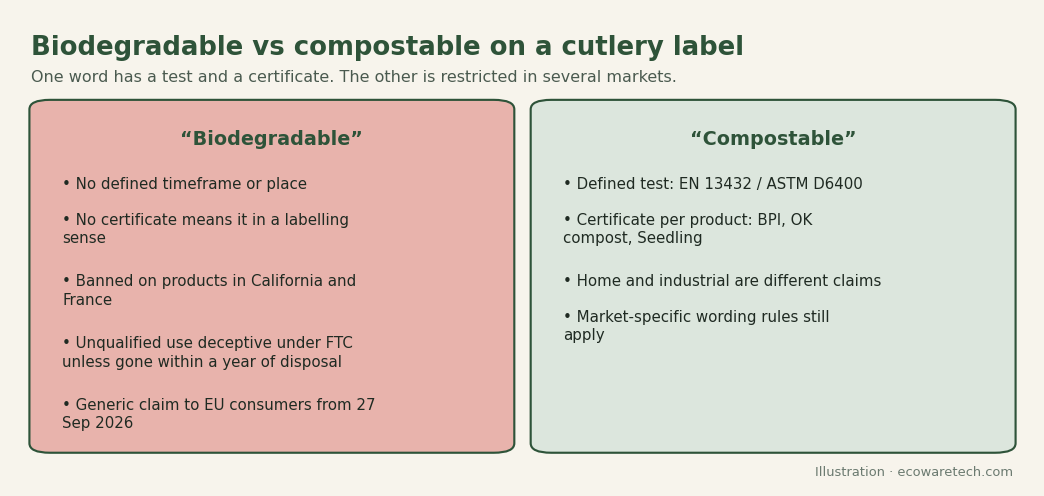
Illustration summarising the table above. Generated for this guide.
Where “biodegradable” is restricted
| Market | Rule | Source |
|---|---|---|
| United States (federal guidance) | It is deceptive to make an unqualified degradable or biodegradable claim if the item does not completely decompose within one year after customary disposal. Items customarily disposed of in landfills, incinerators or recycling facilities generally cannot meet this | FTC Green Guides, 16 CFR 260.8 |
| California | Products may not be labelled “biodegradable”, “degradable” or “decomposable”. The law’s definition of product expressly includes food and beverage containers and their components, including utensils, so it is not limited to plastic | California Public Resources Code §42357 and §42356 |
| France | “Biodégradable” and “respectueux de l’environnement” may not appear on products or packaging; in force since 1 January 2022. A bill under debate in 2026 would soften this, but had not been confirmed as adopted when this page was written | AGEC law (Law No. 2020-105), reproduced on INERIS AIDA; French Senate report on the pending bill |
| European Union | Member States must apply new rules from 27 September 2026 banning generic environmental claims made towards consumers without recognised excellent environmental performance; the rules take effect through national law, and several countries, France among them, had not transposed them by that date. The directive’s recitals give “eco-friendly” and “biodegradable” as examples of generic claims | Directive (EU) 2024/825 |
BPI notes that four US states have made “biodegradable” illegal in marketing single-use products, which is one reason certified compostable products avoid it (BPI).
Two points about scope. The EU directive applies to business-to-consumer practices, because it amends the Unfair Commercial Practices Directive, so it bites on retail packs and consumer-facing menus rather than on a B2B quotation. And California’s rule applies to what is printed on the product and its packaging, so a pack designed for one market can be non-compliant in another.
Where “compostable” has its own conditions
A certified compostable claim is the stronger one, but it is not unconditional:
- US federal guidance: a compostable claim implies home composting too. If the item can only be composted in a facility, or facilities are not available to a substantial majority of buyers, qualify the claim (16 CFR 260.7).
- California: products labelled compostable must meet additional conditions that have applied since 1 January 2026; see our compostable certification guide.
- France: plastic products that only compost industrially may not say “compostable”.
The difference between home and industrial composting is its own subject, covered in home compostable vs industrial compostable.
What this means for wooden and bamboo cutlery
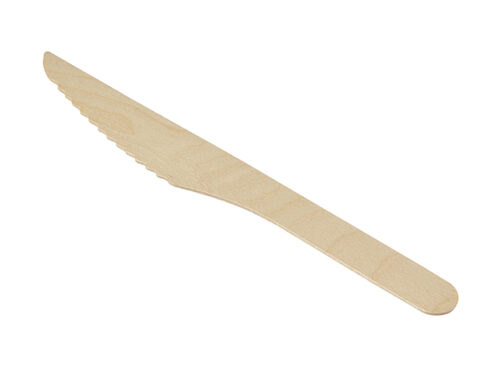
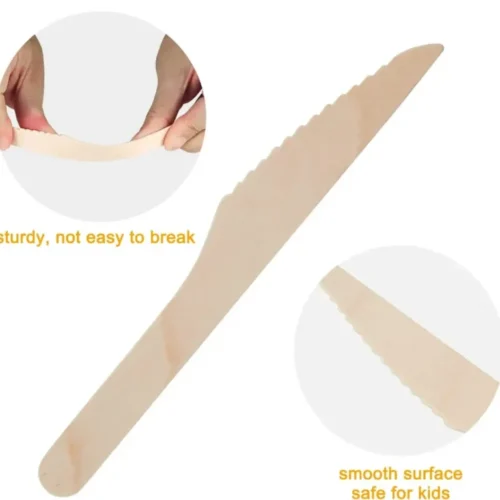
Uncoated wood and bamboo are materials of natural origin. Under EN 13432 they are deemed biodegradable without testing, as TÜV Austria’s comparison document notes, but disintegration, heavy-metal limits and ecotoxicity still have to pass before anything can be certified compostable. So the material is not the problem; the word on the pack is.
| What you want to say | Safer wording | Why |
|---|---|---|
| “Biodegradable wooden cutlery” | “Made from birch wood” or “Plastic-free wooden cutlery”, if accurate | Material facts are specific and checkable; “biodegradable” is banned or restricted in several markets |
| “Compostable” | “Certified compostable” with the certificate mark and number, in the wording the market requires | A compostable claim needs a certificate for that product |
| “Eco-friendly” | A specific, documented fact, such as an FSC claim with the certificate code | Generic claims to consumers are restricted under EU rules applying from 27 September 2026 |
| Nothing at all | No environmental claim | Always lawful, and often the right choice for multi-market packaging |
Washington State shows how a market can treat plain wood differently: products made from wood with no plastic additives, coatings or waxes do not need the compostable labelling that other products must carry (Washington Department of Ecology). That exemption concerns compostable labelling; it does not make “biodegradable” acceptable in California or France.
Buyer checklist before you print
- List every market the pack will be sold in, including online sales into other states and countries.
- Remove “biodegradable” and “degradable” from consumer packaging unless counsel has cleared it for every one of those markets.
- Use “compostable” only with a certificate for that product, and follow each market’s wording rule.
- Replace generic claims with specific material facts you can document.
- Keep the evidence file: certificate, test report, FSC claim, and the date each was checked.
For how long bamboo breaks down outside a certified test, see how long bamboo cutlery takes to decompose. For what the material is, see what wood is wooden cutlery made of.
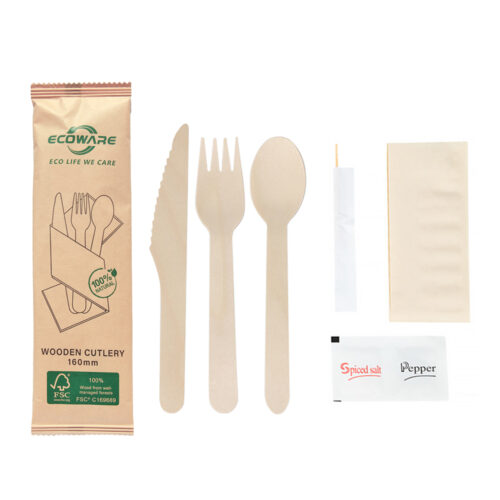
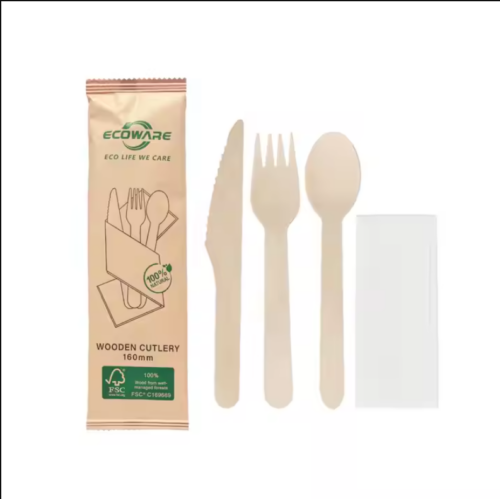
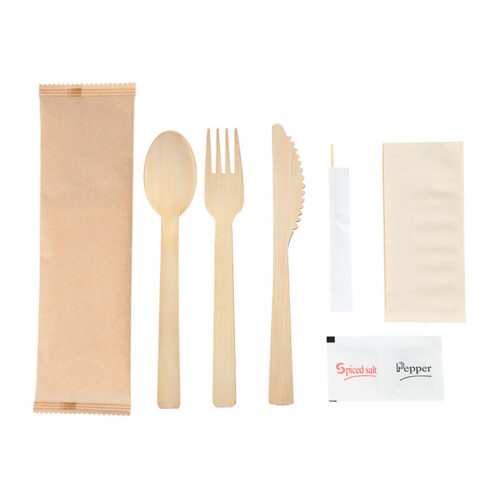
Ecoware does not claim a compostability certification for its cutlery lines. If you need packaging artwork for a specific market, tell us the market when you request a quote, and browse our disposable wooden cutlery sets.
How this guide was made: drafted with AI assistance and edited by Ecoware’s marketing team on 1 October 2026. Legal statements come from the FTC Green Guides, the California Public Resources Code, Directive (EU) 2024/825 and the French AGEC law as reproduced by INERIS; definitions from BPI and TÜV Austria. Each is linked where it is used. This is general guidance, not legal advice. The illustration is generated.