Updated 1 October 2026. Prepared by Ecoware’s marketing team. Test conditions are quoted from the certifiers’ scheme documents; labelling rules link to the statute or regulation.
Short answer: Industrial (or commercial) compostable means a product broke down in tests run at about 58 °C, the temperature of a managed composting facility. Home compostable means it also broke down at ambient temperature, around 20 to 30 °C, over a longer test, which is the harder standard to pass. A product certified only for industrial composting should not be put in a garden heap, and in several markets it should not be labelled in a way that suggests it can. For cutlery buyers the practical questions are which certificate the product actually holds, where the used cutlery will end up, and what the destination market lets you print on the pack.
The two tests side by side
| Industrial / commercial compostable | Home compostable | |
|---|---|---|
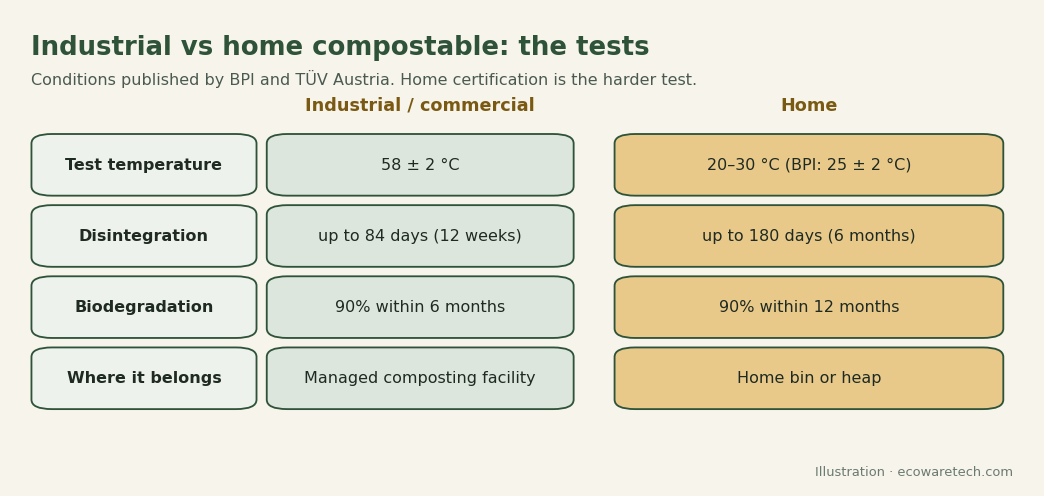
| Test temperature | 58 ± 2 °C | Ambient: 25 ± 2 °C at BPI; 20–30 °C at TÜV Austria |
| Disintegration (falls apart into small fragments) | BPI: up to 84 days. EN 13432 route: after 12 weeks, at most 10% left on a 2 mm sieve | BPI: up to 180 days. OK compost HOME: maximum six months |
| Biodegradation (converted to CO₂) | 90% within 6 months | 90% within 12 months |
| Typical marks | BPI Certified Compostable, TÜV Austria OK compost INDUSTRIAL, Seedling | BPI Commercial & Home, TÜV Austria OK compost HOME, AS 5810 in Australia |
Sources: BPI certification; TÜV Austria’s comparison of compostability standards (Information Document 415) and OK compost HOME certification scheme.
Two details matter for buyers. BPI made commercial certification a prerequisite for home certification, so a BPI home mark always sits on top of a commercial one. And TÜV Austria says plainly that products certified only for industrial composting should not go into the garden compost.
Illustration built from the test conditions in the table above. Generated for this guide.
A common mistake in answers about home composting
Some explanations of this topic say home compost heaps run at 50 to 65 °C. That describes a hot, actively managed pile at best. The certification tests for home compostability are run at ambient temperature, 20 to 30 °C, precisely because an ordinary garden heap or bin cannot be relied on to heat up. If a product passed only the 58 °C industrial test, there is no evidence it will break down in a backyard.
Home-compostable standards are not one standard
Different markets built their own home-compost specifications, and they do not all cover cutlery:
| Standard or scheme | Market | What it covers |
|---|---|---|
| TÜV Austria OK compost HOME | Europe and internationally | A certification scheme for products and materials |
| BPI Commercial & Home | United States and Canada | Products already certified for commercial composting |
| AS 5810 | Australia | Biodegradable plastics suitable for home composting |
| NF T 51-800 | France | Plastic products suitable for home composting |
| EN 17427 | Europe | Carrier bags only, not cutlery |
Scopes are from the standards’ published scope statements, as summarised by AFNOR for NF T 51-800 and TÜV Austria’s scheme documents linked above.
What untreated wood changes
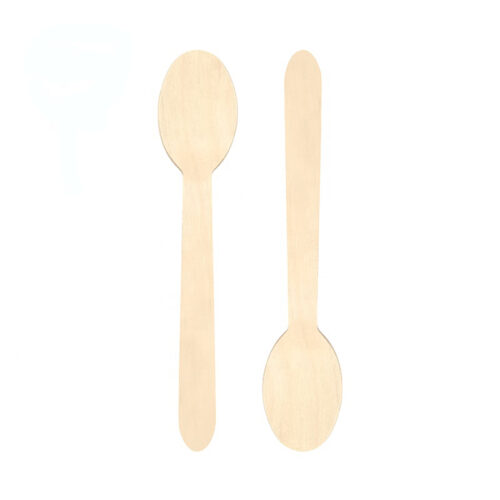
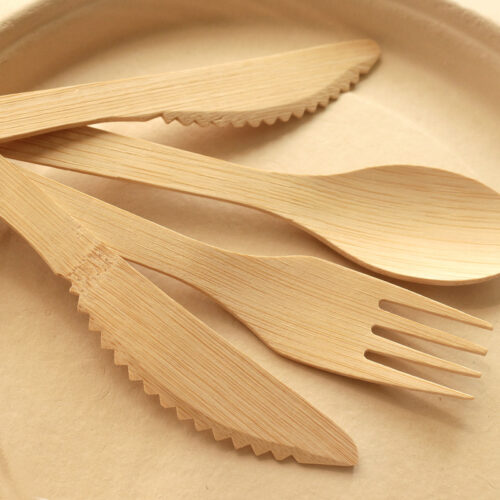
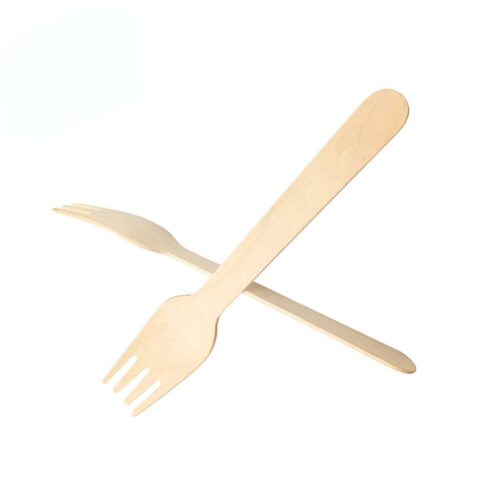
Under EN 13432, materials of natural origin are deemed biodegradable by default, and the OK compost HOME scheme applies the same exemption. TÜV Austria notes that such materials would not actually reach 90% biodegradation within the test period; the exemption recognises that they break down, not that they do so fast. For an uncoated birch fork or bamboo spoon, the biodegradation test is therefore not the hurdle; disintegration at the certified thickness, ecotoxicity and limits on regulated metals still apply. Disintegration is, and it depends on thickness: a thin coffee stirrer and a reinforced knife handle are different test pieces. That is where the home test bites, because the same piece has to fall apart at 20 to 30 °C instead of 58 °C.
Coatings change the answer. A wax, lacquer or plastic film is no longer “material of natural origin”, and it can slow or stop breakdown in either setting.
Where the used cutlery will actually go
Where the used cutlery ends up decides the outcome.
- Commercial composting is not available everywhere, and not every facility accepts packaging. The US Environmental Protection Agency notes that not all composting facilities accept compostable plastics, and its 2021 report cites a 2018 BioCycle survey in which about 48% of responding food-waste composters (49 of 103) accepted compostable plastic products in practice. BPI calls contamination one of the biggest challenges composters face.
- Home composting depends on the customer. A home claim only helps if the end user has a compost bin and uses it.
- Many used forks end up in landfill either way. Neither certification promises anything there.
For the legal side of how cutlery is handed out in the first place, see our guide to utensils-upon-request laws.
What you are allowed to print
Labelling rules are where the difference between home and industrial becomes a compliance question:
| Market | Rule | Source |
|---|---|---|
| United States (federal guidance) | Under the FTC Green Guides, a compostable claim covers composting in an appropriate facility or a home pile. If an item cannot be composted safely and in a timely way at home, the claim should be qualified; the same applies where composting facilities are not available to a substantial majority of consumers | 16 CFR 260.7 |
| California | “Home compostable” may only be used if the manufacturer holds OK compost HOME certification, unless CalRecycle adopts its own standard. The statute also requires products labelled compostable to be an allowable input under the USDA National Organic Program from 1 January 2026; CalRecycle extended that date to 30 June 2027 for products containing synthetic substances | California Public Resources Code §42357 |
| Washington | “Home compostable” is allowed only for products that also meet the industrial standard and are certified, and never as “home compostable only”. Products made only of wood, with no plastic, wax or coatings, are exempt from the certification route; wood and paper food-service products may not contain added PFAS | RCW 70A.455; Washington Department of Ecology |
| France | Plastic products that can only be composted in an industrial unit may not carry the word “compostable”, and no product or packaging may carry “biodégradable” or “respectueux de l’environnement” | AGEC law (Law No. 2020-105), reproduced on INERIS AIDA |
These are summaries, not legal advice. California’s conditions in particular are being phased in and re-interpreted; our compostable certification guide tracks the current position.
Which one should a cutlery buyer ask for?
| Your situation | What to ask the supplier for |
|---|---|
| Customers return cutlery with food waste to a commercial composter | Industrial certification recognised in that market, and confirmation from the composter that it accepts the item |
| You want to print “home compostable” on the pack | A home certification valid in that market (OK compost HOME for California, plus industrial certification for Washington) |
| You sell into France | No “biodégradable” or “environmentally friendly” wording on any pack; no “compostable” on plastic items that compost only industrially |
| You only need a plastic-free product and make no compostability claim | No compostability certificate is legally required; uncoated wood or bamboo, with food-contact documents, may be enough |
Certification is product-specific. BPI’s published fees are $1,500 for a new commercial-only certification and $3,000 for commercial and home, certificates run for three years, and home biodegradation testing alone takes up to 12 months. Ecoware does not claim a compostability certification for its cutlery lines. If your market or customer requires one, send us the SKU and the market and we will set out what certifying it would involve.
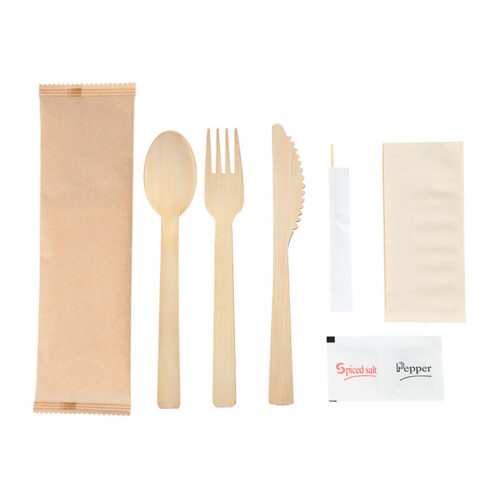
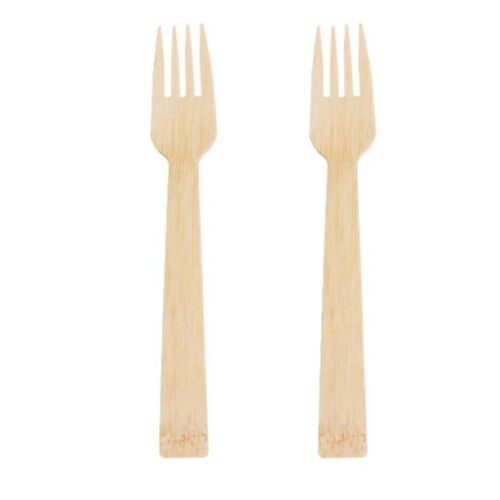
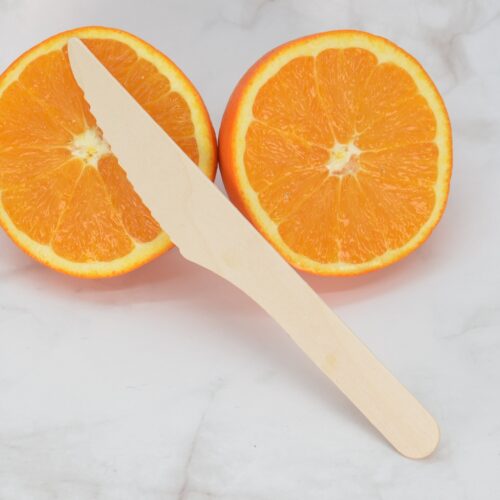
For how long bamboo takes to break down outside a certified test, see how long bamboo cutlery takes to decompose, and for the materials themselves, what wood is wooden cutlery made of. Products: disposable bamboo cutlery.
How this guide was made: drafted with AI assistance and edited by Ecoware’s marketing team on 1 October 2026. Test conditions come from BPI and TÜV Austria scheme documents; labelling rules from the FTC, California and Washington statutes and the French AGEC law, each linked where it is used. This is general guidance, not legal advice. The illustration is generated.
Products in this guide
Related buyer guides
- Biodegradable vs Compostable Cutlery: What Each Label Means and Which One Your Market Accepts
- BPI Certified vs EN 13432 vs OK Compost: Compostable Certification by Market
- Are Disposable Bamboo Chopsticks Compostable? What Makes Them Eco-Friendly, and What Doesn’t
- How Long Does Bamboo Cutlery Take to Decompose? Compost, Soil and Landfill Compared