
Updated 16 October 2026. Prepared by Ecoware’s marketing team. Rules and test findings link to the regulator, standard or published source.
Short answer: Yes, uncoated disposable bamboo chopsticks can be composted. EN 13432 treats chemically unmodified natural materials such as untreated wood as biodegradable without testing, and Washington State names wooden chopsticks among the wood-only products that do not need its compostable labelling (Washington Department of Ecology). Chopsticks certified as industrially compostable must disintegrate within 12 weeks at about 58 °C; uncertified ones have no test limit. Used chopsticks go in a food-scrap or compost bin where the local facility accepts them. Lacquer, dye or plastic changes the answer, and “compostable” or “biodegradable” on the pack is a separate legal question.
Bamboo, wooden and plastic chopsticks compared
Bamboo and wooden chopsticks behave alike in compost; plastic ones do not:
| Feature | Disposable bamboo | Disposable wooden (birch, aspen) | Plastic (reusable) |
|---|---|---|---|
| Material | Bamboo culm, botanically a grass | Hardwood such as birch or aspen | A polymer; ask the maker which one |
| Breaks down in compost | Yes, if uncoated and the facility accepts it | Yes, on the same conditions | Not unless the plastic itself is certified compostable |
| Label “compostable” | Depends on the market; certification where the market requires it | Same | Only with a certificate for that product |
| Label “biodegradable” | Restricted; banned on products in California and France | Same | Same |
| Main question to ask | Coating, bleaching, moisture control | Same, plus surface finish (splinters) | Which polymer, and its heat limits |
| Typical use | Takeaway, restaurants, events | Takeaway, restaurants | Homes and restaurants that wash and reuse |
For the shapes themselves, such as tensoge, round and twin chopsticks, see types of chopsticks.
What happens between the bamboo and the pack
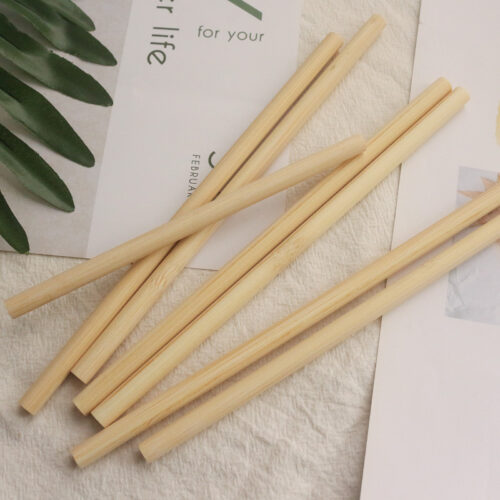
A disposable, single-use bamboo chopstick is split, shaped, dried and polished. Some bamboo products are also treated with sulphur, and that is where the questions start:
- Sulphur treatment. Hong Kong’s Consumer Council tested 18 bamboo toothpick and skewer samples (no chopsticks). Seventeen contained sulphur dioxide, all within the 600 mg/kg limit of the mainland Chinese standard for bamboo chopsticks, but five exceeded the 100 mg/kg level in a draft mainland standard for toothpicks (Consumer Council, 2011). Ask whether any sulphur treatment is used.
- Mould. The same test found mould above the reference level in two bamboo skewer samples, and the council advised storing bamboo products dry and discarding mouldy ones. Our guide to mould on wooden cutlery explains moisture control.
- Colour. Darker “carbonized” chopsticks and dyed or lacquered ones look similar. Ask whether the colour comes from heat treatment, a dye or a coating, because only uncoated bamboo stays a purely natural material.
For chopsticks sold in China, GB 4806.12-2022, the national standard for bamboo and wood food-contact materials, has applied since 30 December 2022 and sets migration limits. In the United States, the FDA Food Code names chopsticks among the wooden utensils allowed in food businesses when they are made of hard maple or an equivalently hard, close-grained wood. The code does not mention bamboo.
Where used chopsticks should go
Used bamboo chopsticks belong in a compost or food-scrap bin where the local facility accepts them, and in general waste where it does not.
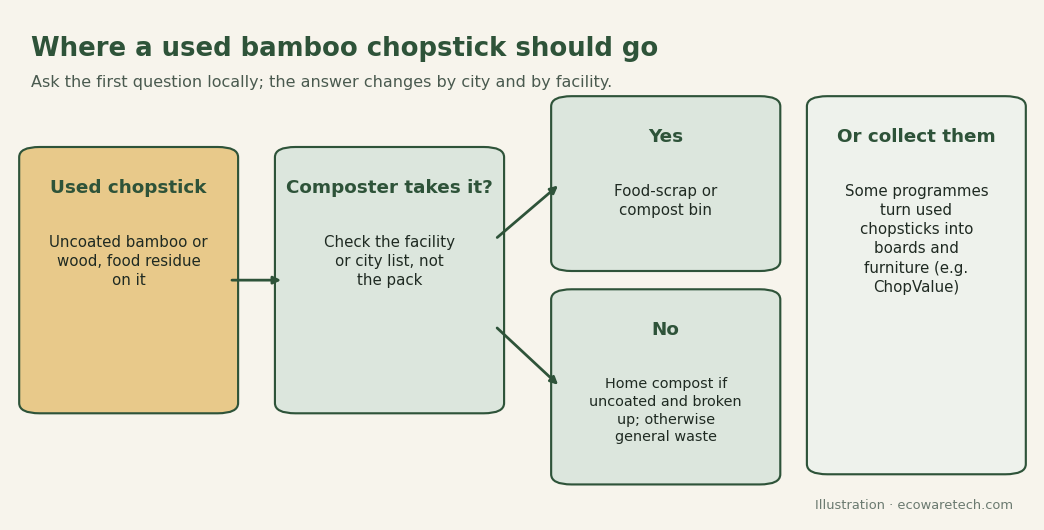
Illustration: disposal options for used chopsticks. Generated for this guide.
- Commercial composting, where accepted. Check the facility’s or city’s list of accepted items rather than the pack. Composters reject what they cannot process, and acceptance rules differ from one facility to the next.
- Home composting. Uncoated bamboo breaks down in a home heap more slowly than in a managed facility: BPI allows up to 84 days for disintegration in its commercial test at 58 °C and up to 180 days in its home test at 25 °C. Our guide to how long bamboo takes to decompose gives the timelines by route.
- Collection and reuse of the material. Some businesses collect used chopsticks from restaurants. ChopValue, founded in Vancouver in 2016, turns them into boards and furniture and reported passing 150 million chopsticks repurposed in April 2024.
- General waste. The US Federal Trade Commission treats landfills as places where complete decomposition within one year does not happen, so a bamboo chopstick there will not break down the way it does in compost.
What you can print on the pack
Bamboo chopsticks can compost, but the wording on a chopstick pack is regulated separately in each market.
- “Compostable” is the stronger claim. California requires products labelled compostable to meet the applicable standard and, where an approved certifier exists, to be certified (California Public Resources Code §42357). Washington is more relaxed for plain wood: products made only of wood, with no plastic, coating or wax, do not need its compostable labelling, and the state names wooden chopsticks as an example (Washington Department of Ecology). A home claim needs home certification. See home compostable vs industrial compostable and compostable certification by market.
- “Biodegradable” is banned on products, including utensils, in California (California Public Resources Code §42357), and on products and packaging in France (AGEC law, via INERIS). In the US generally, the FTC Green Guides treat an unqualified biodegradable claim as deceptive if the item does not completely decompose within one year after customary disposal. A 2026 French bill may soften the French rule; the current status and full comparison are in biodegradable vs compostable cutlery.
- A material fact, such as “made from bamboo” or “plastic-free”, is often the safest wording for a pack sold in several markets, provided it is accurate.
The sleeve counts too
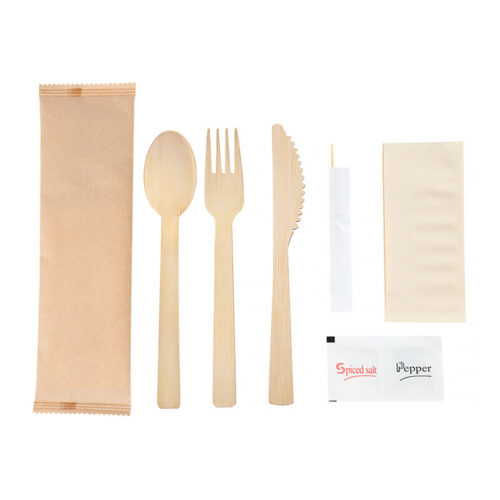
Many disposable chopsticks are sold in a paper or plastic sleeve, sometimes with a toothpick or napkin. A plastic sleeve undoes much of the point of a bamboo chopstick. A paper sleeve brings its own rules: several US states restrict intentionally added PFAS in food packaging, Washington bars added PFAS in wood and paper food-service products, the EU Packaging and Packaging Waste Regulation restricts PFAS in food-contact packaging from 12 August 2026, and the EU also restricts PFHxA in paper and board food-contact materials. See our guides to US state PFAS rules for foodware and the EU PFHxA restriction for food-contact paper.
Common questions
Do chopsticks go in compost? Wooden and bamboo chopsticks go in compost where the local facility accepts them; check the facility’s list of accepted items. Lacquered or plastic chopsticks generally do not, unless they are certified compostable.
Are all chopsticks made of bamboo? No. Disposable chopsticks are made of bamboo or of wood such as birch, and reusable ones come in other materials, including plastic and metal.
Checklist before you order disposable chopsticks
- Species and form: bamboo or wood, length, style (tensoge, round, twin).
- Treatment in writing: no coating or dye, or which one; whether any bleaching or sulphur treatment is used.
- A food-contact test report for your market from an accredited laboratory, with conditions and date.
- Moisture and mould controls: how the batch is dried, packed and stored.
- Sleeve material and, for paper, the PFAS position for your market.
- Pack wording checked for every market where it will be sold.
- The certificates the factory actually holds; ours are listed on our factory page. Wooden alternatives are in our disposable wooden chopsticks range.
Where Ecoware fits
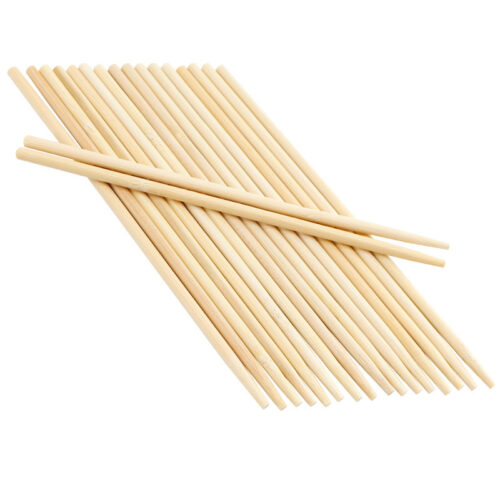
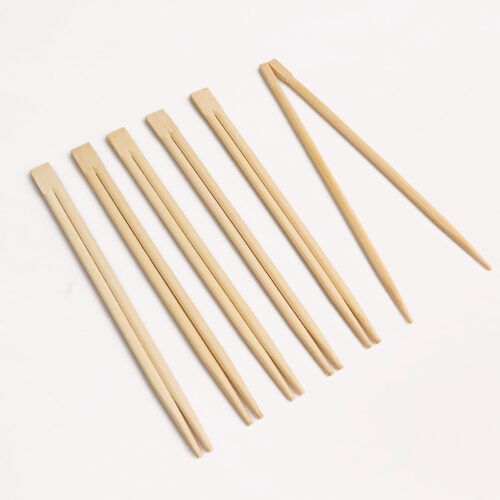
Ecoware Co., Ltd. is the export company of the factory Shucheng Limin Wood Products Co., Ltd., which makes disposable bamboo chopsticks in tensoge, round and twin styles, along with disposable wooden chopsticks. Ecoware does not claim a compostability certification for its chopsticks. Ask for the treatment declaration and test report for the exact item when you request a quote.
How this guide was made: drafted with AI assistance and edited by Ecoware’s marketing team in October 2026. Test findings come from the Hong Kong Consumer Council; standards and rules from the FDA Food Code, China’s national standard as summarised by the Food Packaging Forum, the California Public Resources Code, Washington’s Department of Ecology, the French AGEC law and the FTC Green Guides. No product testing was carried out for this article. The illustration is generated.
Related Articles
- Types of Chopsticks: 9 Styles Explained (Sizes and Uses)
- Biodegradable vs Compostable Cutlery: What Each Label Means
- Are Wooden Plates Safe to Eat On? Wooden Plates vs Plastic, Metal and Ceramic
- Ecoware at MIFB 2026: Sustainable Bagasse & Bamboo Tableware in Malaysia
- Browse all articles & products →
Products in this guide
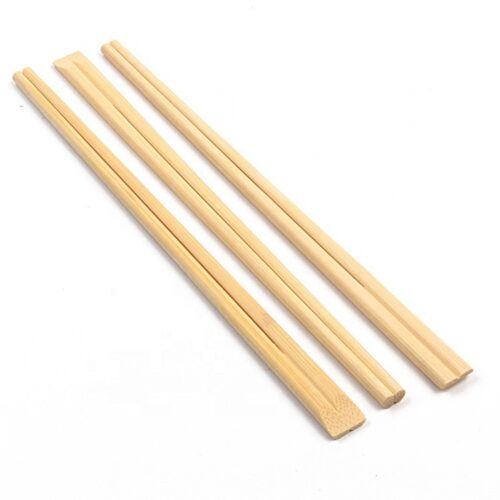
See all Disposable Bamboo Chopsticks → Request free samples →