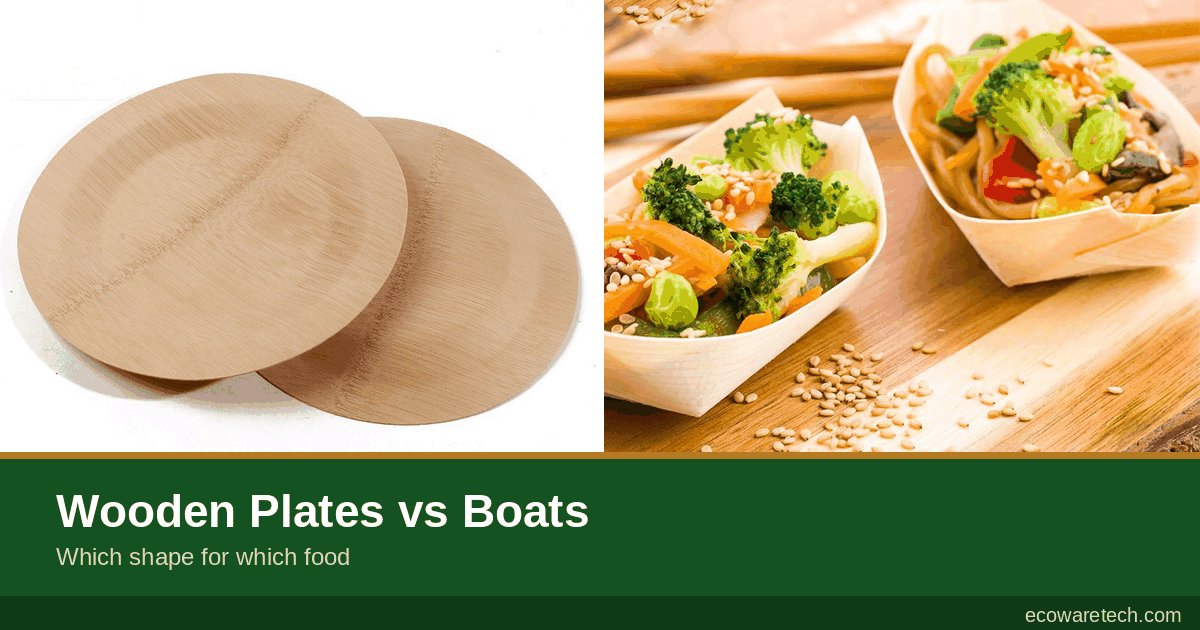
Quick answer: Plates (round or square, flat) suit dry or lightly sauced food such as appetizers, pastries and sandwiches. Boats (elongated, with raised sides) hold sushi, dumplings and other long, handheld items where a little moisture needs to stay contained along one axis. Neither shape is the right call for soup or a heavily sauced dish held for a long time; a lined bowl or cup handles that better. The rest of this guide walks through Ecoware’s real plate and boat options and where each one earns its place on a table.
Plate vs Boat: Quick Comparison
| Shape | Best for | Ecoware options | Handles liquid? |
|---|---|---|---|
| Round or square plate | Dry or lightly sauced food, apps, pastries, sandwiches | Round bamboo plate; square bamboo plate; round wooden plate; square wooden plate | Poorly. Flat surface, no containment. |
| Boat (elongated, raised sides) | Sushi, dumplings, long handheld items | Wooden boat, 3 to 9 inch size range | Some. Raised sides contain light sauce along one axis. |
| Neither (use a lined bowl or cup) | Soup, high-liquid or long-hold sauced entrees | Bagasse pulp bowl (separate product line) | Yes, that is what the shape is for. |
Source: shape and category names confirmed from Ecoware’s live product-category pages (linked under Related Guides below). Exact plate dimensions are not published there; ask your Ecoware contact for a spec sheet if you need an exact footprint for packaging or case-pack planning.
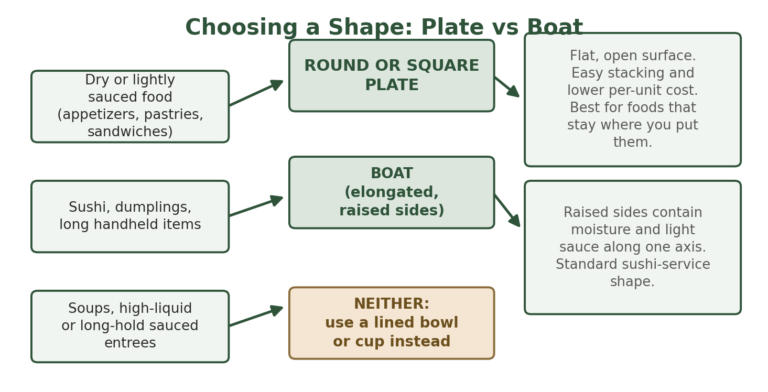
How the food type maps to a plate, a boat, or neither. Illustrative diagram built from the reasoning in this article.
Round and Square Plates
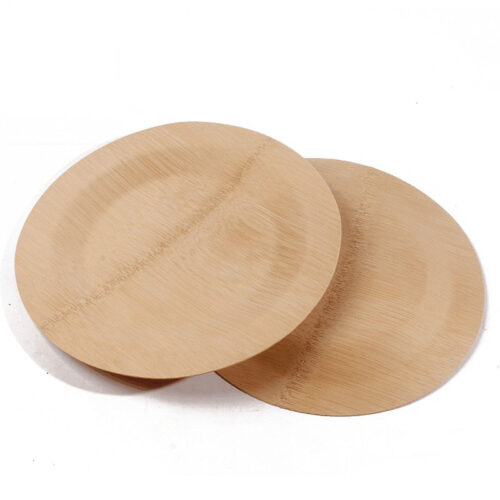
Ecoware stocks both round and square plates in bamboo and in wood, and the shape choice here is mostly a presentation decision rather than a functional one. A round plate reads as the more traditional, casual choice; a square plate is often picked for a more structured, modern table setting or for a catering line that wants edges to align cleanly when plates are set side by side. Neither shape changes how well the plate handles food, since that comes down to material and whether the food is wet or dry, not the outline.
Boat-Shaped Trays
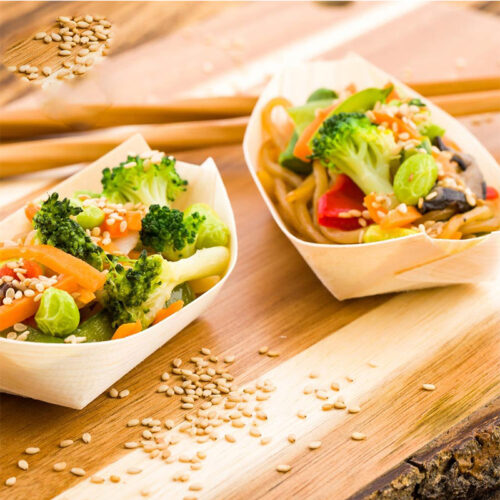
A boat is a long, narrow tray with raised sides, and Ecoware’s wooden boat runs from about 3 to 9 inches depending on the size ordered. The raised sides are the whole point of the shape: they keep a piece of sushi, a dumpling, or a skewer of food from rolling off the way it could on a flat plate, and they contain a small amount of soy sauce or dip along the length of the tray. This is the standard shape for sushi service for exactly that reason, and it works equally well for any other long, handheld food that a flat plate would let slide around.
Wood or Bamboo: Which Material Handles Which Food
Both materials are rigid enough for appetizers, small plates and handheld portions, and neither needs a plastic lining to hold its shape under normal serving conditions. Wood performs best with dry to lightly sauced food; a page from a major foodservice supplier that this guide checked directly describes wood as prone to noticeable seepage and softening under high-liquid items or long holding times. Bamboo holds up a little better than plain wood under warm, moderately moist food, but the same source is clear that bamboo is not the right choice for soups or high-sauce entrees held for an extended period either. In practice, the material does not change the plate-versus-boat decision above so much as it sets the outer limit of what either shape should be asked to hold.
When to Skip the Plate or Boat Entirely
Soup, a heavily sauced entree, or anything held for more than a short serving window belongs in a lined bowl or cup, not on a plate or in a boat. Pushing a wet food onto a flat or shallow shape just moves the seepage problem from “will this hold” to “how long until it fails.” Ecoware’s bagasse pulp bowl line is built for that job instead; see it under Bagasse Pulp Bowl Cups if a boat or plate is not the right fit for what you are serving.
Frequently Asked Questions
Can a wooden boat replace a bowl for soup?
No. A boat’s raised sides contain a small amount of sauce along one axis; they are not deep or sealed enough for soup or a fully liquid dish. Use a lined bowl or cup for that instead.
Are bamboo plates stronger than wooden plates?
Both are rigid enough for normal serving use. The practical difference is moisture handling: bamboo tolerates warm, moderately moist food a little better than plain wood, but neither is built for soup or long-held sauced dishes.
What size are Ecoware’s wooden boats?
The wooden boat line runs from about 3 to 9 inches. Ask your Ecoware contact for the full size and case-pack breakdown if you need an exact footprint for packaging.
Is a square or round plate better for catering?
Neither is functionally better. Square plates align more cleanly when set side by side on a catering line; round plates read as more traditional. Pick based on presentation, not performance.
Related Guides
This page is not part of the spoon, fork or bamboo-pick classification series already published on this site; it stands on its own. Where the topic overlaps, it links out rather than repeating that content.
- Bamboo vs Birchwood Cutlery. For material-level detail (cost, UX and physics) beyond what this shape-focused page covers.
- Product line: Compostable Bamboo Plates, Disposable Wooden Plate and Boat and Bagasse Pulp Bowl Cups.
About Ecoware
Ecoware Co., Ltd. sells disposable wooden and bamboo tableware made at its family factory in Shucheng, Anhui province, China (Shucheng Limin Wood Products Co., Ltd., established 2008). The company supplies FSC Chain-of-Custody certified birch and bamboo product lines alongside food-contact compliance documentation (FDA 21 CFR 176.170, EU 10/2011 and LFGB testing on request) for import buyers who need paperwork ready before a shipment clears customs.
The figures in this guide come from a mix of independently published wood-science and materials data (cited inline), Ecoware’s own in-house product testing published on ecowaretech.com, and standard-setting bodies (ASTM, BPI, TÜV Austria, the EU). Where a number could not be independently verified, this guide says so rather than estimating one, and points you to where you can request the missing spec sheet directly from Ecoware.
Need an exact plate or boat spec sheet for your order? Request a quote →
Related Articles
Products in this guide
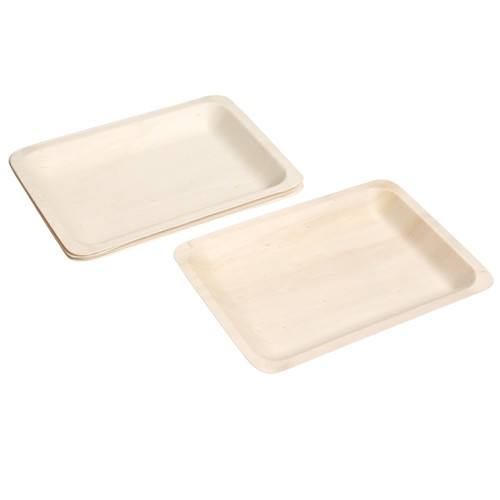 Disposable Wooden Square Plate
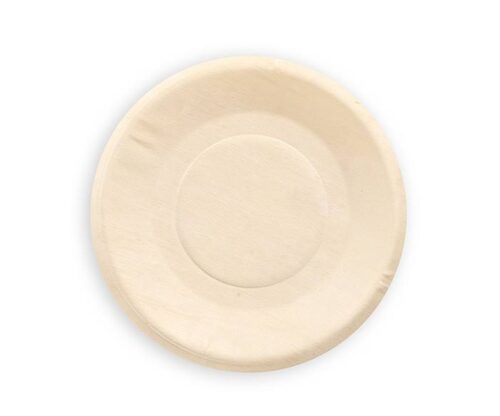 Disposable Wooden Round Plate
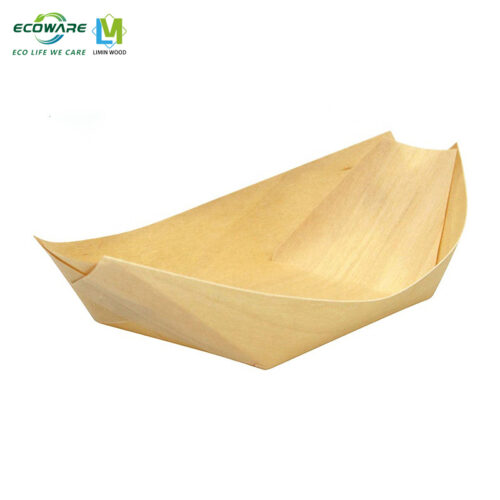 Disposable Wooden Boat Handicraft For Foods 3-9 inch Sushi Boat
See all Disposable Wooden Plate And Boat → Request free samples →