Updated 1 October 2026. Prepared by Ecoware’s marketing team. Statements about Chinese registration rules link to the government or legal source.
Short answer: A manufacturer owns the production lines; a trading company buys from factories and resells, adding its own margin and services. Neither is bad, but you need to know which you are dealing with, because it decides who answers for a defect and who can change your production slot. Three pieces of evidence settle it better than any sales claim: the business licence and its public registration record, a live look at the production site named on that record, and certificates whose site address and scope match it. Two common “proofs” settle nothing: having export rights, since every registered Chinese business has them, and holding an FSC certificate, which traders need too.
Manufacturer, trading company, or both
| Manufacturer | Trading company | Factory with a separate sales company | |
|---|---|---|---|
| Owns production lines | Yes | No | Yes, under a different legal entity |
| Who invoices you | The factory | The trader | Often the sales company |
| Price | Factory price, sometimes higher MOQ | Factory price plus margin | Depends on the arrangement |
| Strength | Direct control of spec, schedule and changes | Can combine several product types and smaller orders in one shipment | Factory control with an export-focused sales team |
| Risk | Narrower product range | The trader may switch factories without telling you | Certificates and licence may sit with the factory, not the company you pay |
The third column is the one that causes the most confusion. A factory may sell through a sister company that handles export paperwork and payments. That is legitimate, but the documents should show how the two companies are connected, and your contract should name the manufacturing site.
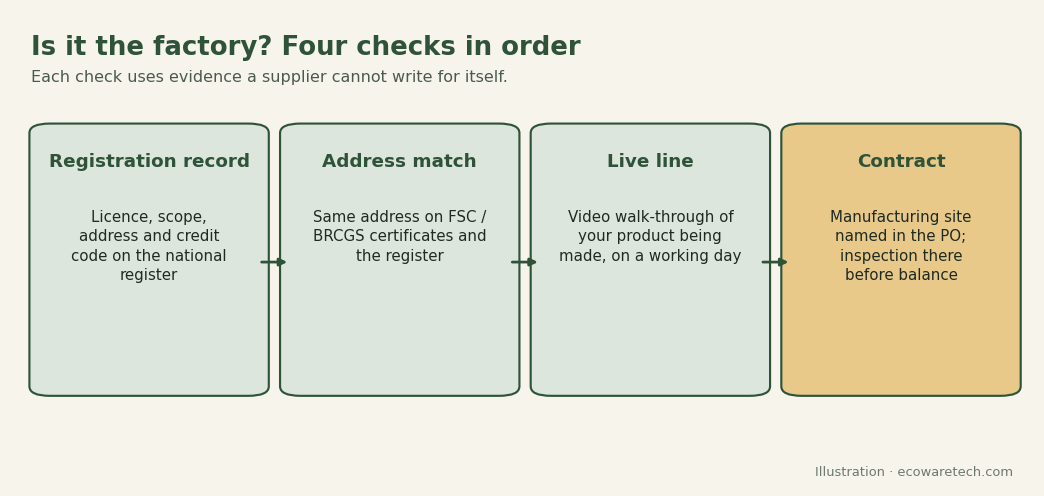
Illustration: the order of checks in this guide. Generated for this guide.
What actually proves it
| Claim | Evidence that settles it | Evidence that does not |
|---|---|---|
| “We are the factory” | Registration record showing a production address and manufacturing in the business scope; a live video walk through that address on a working day | Showroom photos, a catalogue, a website “About us” page |
| “We have our own export licence” | Nothing. China stopped separate foreign-trade operator registration on 30 December 2022, so every registered business can import and export | Any document presented as an “export right” |
| “Our factory is FSC certified” | The FSC certificate’s holder name, site address and product scope, checked on the FSC public search | The certificate alone: traders also hold FSC chain-of-custody certificates |
| “We are BRCGS certified” | A BRCGS Packaging Materials certificate whose site code appears in the BRCGS Directory at the factory address | A BRCGS Agents and Brokers certificate, which is written for companies that do not manufacture |
| “This is our production line” | Machines running the product you are buying, with the cartons and labels you saw in the quote | A generic production video with no identifiable location |
How to read a Chinese business licence
Every Chinese company is registered with the market regulator, and the core items on the licence are set by law: the name, the type of entity, the business scope, the registered address, the registered capital and the legal representative (State Council regulations on market entity registration, in force since 1 March 2022). Registration records, annual reports and administrative penalties are published on the national enterprise credit information system, gsxt.gov.cn, where you can search by company name or unified social credit code.
Three things to check on that record:
- Business scope. Companies choose their scope entries from the regulator’s standard catalogue, and production entries are worded differently from sales entries: a manufacturer’s scope typically includes making or processing the product, while a trader’s lists sales or wholesale only. Treat this as evidence rather than proof: since 2021, regulators do not penalise companies for non-licensed activities outside their registered scope, as King & Wood Mallesons summarises the State Council’s reform; activities that need a licence still need one.
- Registered address. Does it match the address on the certificates and the place you were shown on video? A city-centre office address for a company claiming a factory is a question to ask, not a verdict, since some factories register a head office separately.
- The unified social credit code. Match it to the code on the contract and the commercial invoice. If they differ, you are paying a different company from the one you checked.
The registration site is in Chinese and may block access from outside China. A sourcing agent, inspection company or Chinese-speaking colleague can pull the record for you.
Why “export rights” and customs registration prove nothing
Two things suppliers sometimes present as proof of being a factory are now available to every registered business:
- Foreign-trade rights. China’s Ministry of Commerce stopped foreign-trade operator registration from 30 December 2022 after the Foreign Trade Law was amended, so import and export rights no longer need a separate registration.
- Customs registration. Under the General Administration of Customs’ current rules, any registered business can register as a consignor or consignee at the same time as its business registration.
Why certificates need a second look
Certificates help only when you read who holds them and where:
- FSC. Chain-of-custody certification is required for any organisation that takes legal ownership of FSC-certified products and sells them with FSC claims, traders included, and the chain-of-custody standard FSC-STD-40-004 lets a certificate holder outsource certified activities to contractors that are not themselves certified. Look the certificate up on the FSC public search and check the sites listed.
- BRCGS. Every audited location has a permanent site code, and a site code that cannot be found in the BRCGS Directory is either wrong or not a genuine BRCGS code, according to BRCGS. BRCGS also runs a separate Agents and Brokers standard for companies that buy, sell or arrange trade but do not manufacture. Which standard a supplier holds tells you a lot.
Our guide to certifications a disposable cutlery supplier should hold covers the other documents and where to verify each.
When a trading company is the better choice
Buying from a trader is a reasonable decision when:
- you need several product types, such as wooden cutlery, paper straws and bagasse plates, in one container, and no single factory makes all of them;
- your order is below the factory’s MOQ and the trader can consolidate it with other orders;
- you want one English-speaking contact handling documents, inspection booking and shipping.
The trade-off is control. Write the manufacturing site into the purchase order, ask to be told before any change of factory, and book the inspection at the named site.
Questions to send before the sample stage
- What is the full legal name and unified social credit code of the company that will invoice us, and of the company that manufactures the goods?
- If they are different companies, how are they related?
- Can you do a live video walk-through of the production line for our product this week?
- Which certificates cover the manufacturing site, and what are the certificate numbers?
- Will you name the manufacturing site in the contract and accept inspection there before balance payment?
A supplier that is the factory can usually answer all five within a day.
Where Ecoware fits
We run our own production in Anhui, from birch logs to packed cutlery, and our factory page describes the site. Apply the same questions to us: ask for the business licence of the company that invoices you and of the company that makes the goods, and for a live walk-through of the line for your product. For the full vetting process, see how to choose a wooden cutlery manufacturer in China, and for an example of how a buyer’s team audited our plant, a buyer’s factory inspection case. Related reading: bamboo vs birchwood cutlery for B2B buyers and bamboo tableware supply chain planning. When you are ready, request a quote.
How this guide was made: drafted with AI assistance and edited by Ecoware’s marketing team on 1 October 2026. Registration and customs rules link to Chinese government sources; certificate rules to FSC and BRCGS. This is general guidance, not legal advice.