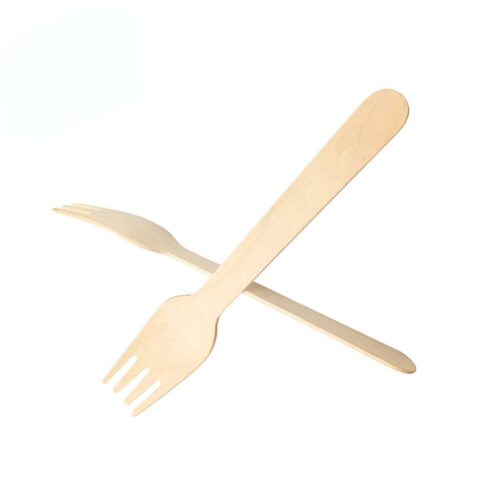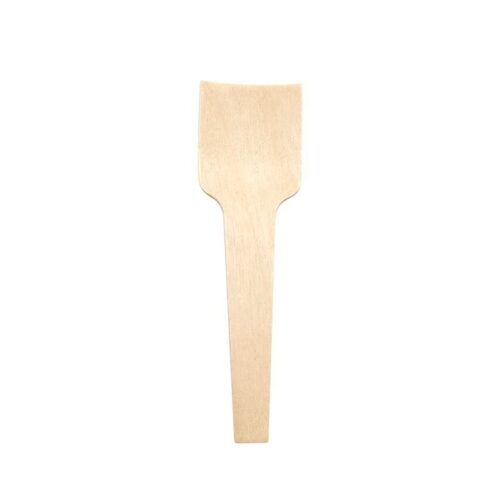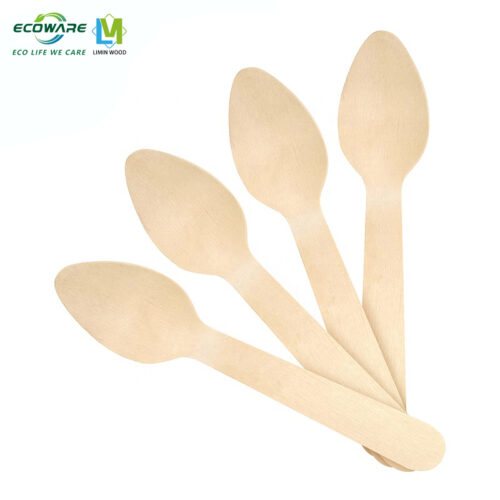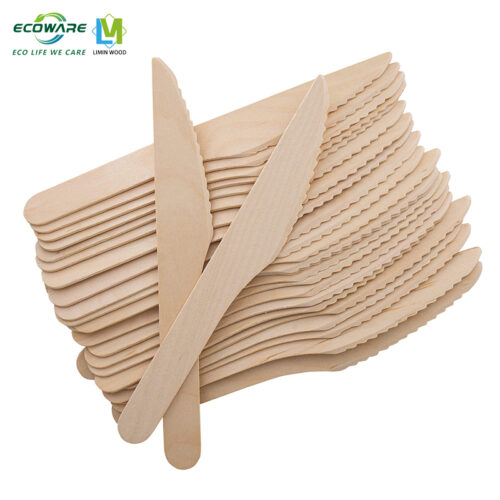
Updated 1 October 2026. Prepared by Ecoware’s marketing team. Tariff headings were read from the US, UK and EU tariff databases on that date. This page deliberately gives no duty rates: they change, and the official databases linked below are the only reliable place to read them on your entry date.
Short answer: Wooden and bamboo cutlery is classified under HS heading 4419, “Tableware and kitchenware, of wood”. Bamboo counts as wood for this chapter. At six digits, bamboo items sit in 4419.11, 4419.12 (chopsticks) or 4419.19, items of certain tropical woods in 4419.20, and birch and other woods in 4419.90. The United States splits these further and gives forks and spoons their own 8-digit lines, separate from knives and other items. That split matters because China-specific additional duties do not cover every 4419 line the same way. Plastic cutlery (3924) and metal cutlery (8215) are different headings entirely.
The 4419 structure
| HS subheading | Description | Typical cutlery item |
|---|---|---|
| 4419.11 | Of bamboo: bread boards, chopping boards and similar boards | Bamboo boards, not cutlery |
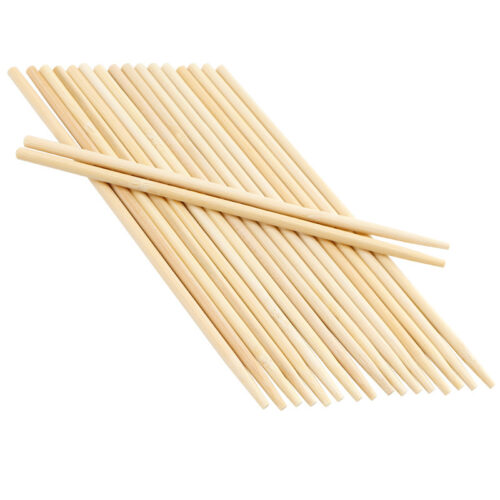
| 4419.12 | Of bamboo: chopsticks | Disposable bamboo chopsticks |
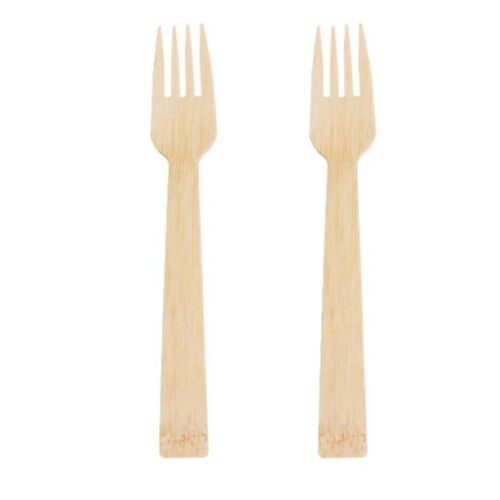
| 4419.19 | Of bamboo: other | Bamboo forks, spoons, knives, stirrers |
| 4419.20 | Of tropical wood | Cutlery made from listed tropical species |
| 4419.90 | Other | Birch and other non-tropical wood forks, spoons, knives, stirrers |
Sources: UK Trade Tariff, heading 4419; EU TARIC, heading 4419. The reason bamboo lands here is Chapter 44 note 6: any reference to “wood” in a heading of the chapter also applies to bamboo and other woody materials (UK Trade Tariff, Chapter 44 notes).
The US split: forks and spoons vs everything else
The Harmonized Tariff Schedule of the United States adds digits to each subheading, and within 4419 it separates forks and spoons from other articles:
| HTSUS line | Description |
|---|---|
| 4419.11.00 | Bamboo: bread boards, chopping boards and similar |
| 4419.12.00 | Bamboo: chopsticks |
| 4419.19.10 | Bamboo: forks and spoons |
| 4419.19.90 | Bamboo: other |
| 4419.20.10 | Tropical wood: forks and spoons |
| 4419.20.90 | Tropical wood: other |
| 4419.90.11 | Other wood: forks and spoons |
| 4419.90.91 | Other wood: other |
Source: USITC HTS search for 4419, read 1 October 2026.
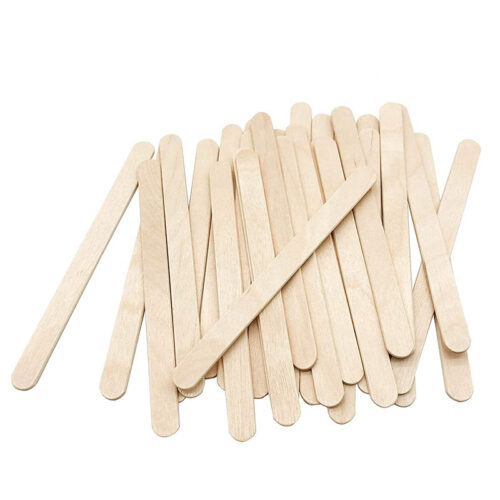
So a birch fork and a birch knife from the same factory can sit on different US lines. Stirrers and ice cream sticks are not forks or spoons and may fall under an “other” line; search CBP’s CROSS rulings for comparable items before you declare them. This is why the commercial invoice should list each item type separately rather than “wooden cutlery”.
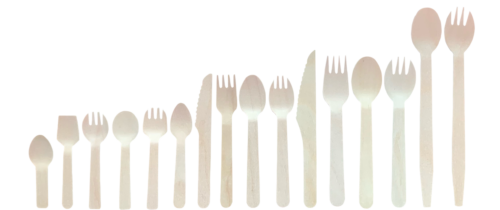
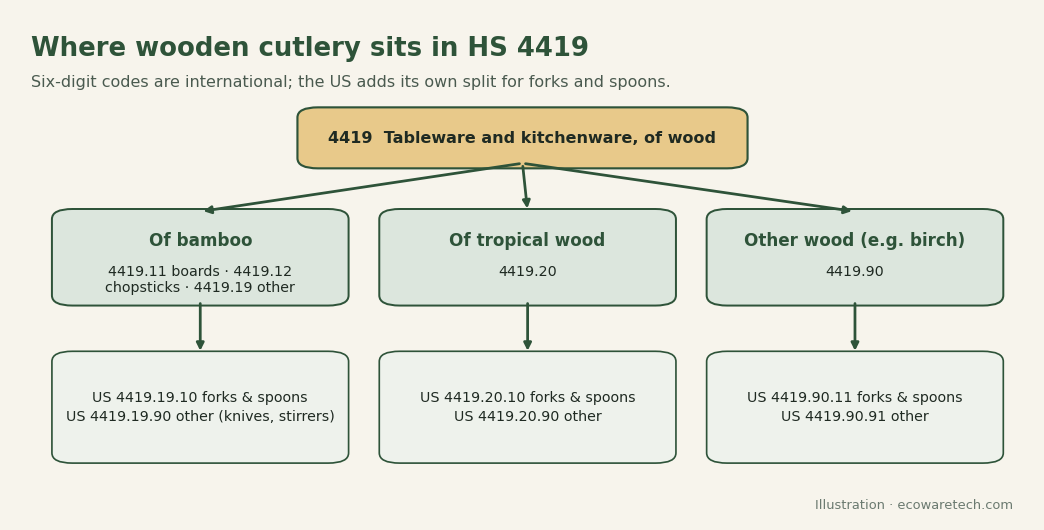
Illustration of the heading structure in the tables above. Generated for this guide.
Additional duties on China-origin goods
On top of the ordinary duty, goods from China can carry additional duties listed in Chapter 99 of the HTSUS, including those under Section 301. These lists name individual 8-digit lines, and they do not treat all 4419 lines alike. In the HTSUS revision current on 1 October 2026, the active Section 301 list (heading 9903.88.15) named 4419.20.90 and 4419.90.91, several other 4419 lines appeared only on a suspended list (9903.88.16), and the forks-and-spoons lines 4419.20.10 and 4419.90.11 did not appear on either (USITC, Chapter 99; USTR, Section 301 tariff actions).
Two cautions. Bamboo forks and spoons (4419.19.10) appeared only on the suspended list, and that list still prints a superseded code, 4419.90.10, so match lines by description as well as number. And some Chapter 99 headings apply to all products of China whatever the 8-digit line, so a line missing from the Section 301 lists does not on its own mean there is no China-specific duty. These measures changed several times in 2025 and 2026; read Chapter 99 for your exact line on your entry date, or ask your customs broker. Do not rely on a rate quoted by a supplier, a blog or this page.
Sets and mixed items
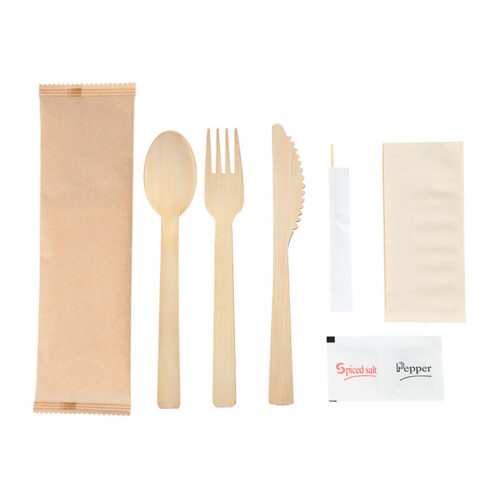
A pack containing a fork, knife, spoon and napkin is not automatically classified as “forks and spoons”. Goods put up in sets for retail sale follow General Interpretative Rule 3(b), which classifies the set by the component that gives it its essential character, and the answer can differ by market. Searching CROSS for wooden cutlery sets shows how CBP has ruled on comparable sets. If a set is a large part of your business, get a binding ruling (see below) before the first shipment.
Headings that look similar but are not 4419
| Item | Heading | Why |
|---|---|---|
| Plastic forks, spoons, knives (including CPLA and PLA) | 3924 | Tableware of plastics (UK Trade Tariff, 3924) |
| Metal spoons and forks | 8215 | Base-metal kitchen and tableware (UK Trade Tariff, 8215) |
| Knives with a metal cutting blade, even with a wooden handle | Chapter 82 | The blade decides the heading; check 8211 with your broker |
| Bagasse or paper cutlery | Paper or pulp headings | Not wood; classify by material |
Building landed cost without guessing rates
Landed cost is everything you pay to get the goods to your warehouse. Build it line by line, using your own quotes for the variable lines:
| Line | What goes in | Where the figure comes from |
|---|---|---|
| Product cost | Supplier price at the agreed Incoterm (for example FOB Shanghai) | Your quotation |
| International freight and insurance | Sea or air freight to your port, plus cargo insurance | Your forwarder |
| Customs value | US: transaction value, which excludes international freight and insurance (19 U.S.C. 1401a). EU: includes transport and insurance up to the EU border (European Commission guidance). UK: includes delivery costs up to the UK border (GOV.UK) | The rule for your market |
| Duty | Customs value × the rate for your line, plus any Chapter 99 additional duty in the US | US HTS, EU TARIC or UK Trade Tariff on your entry date |
| US fees | Merchandise Processing Fee on formal and informal entries (19 CFR 24.23); with de minimis suspended, courier samples usually pay it too; and Harbor Maintenance Fee on sea cargo through listed ports (19 CFR 24.24) | Your customs broker |
| Import VAT (EU and UK) | Charged on customs value plus duty plus incidental costs to the first destination (EU VAT Directive; GOV.UK) | National VAT rate |
| Port, broker and inland delivery | Terminal handling, customs brokerage, trucking | Your forwarder and broker |
Two practical notes:
- Small parcels no longer skip duty in the US. Duty-free de minimis treatment for goods from China ended on 2 May 2025 (White House fact sheet) and was then suspended for all countries; a CBP interim final rule of June 2026 extends that indefinitely for all modes other than international post. Samples sent by courier are affected too.
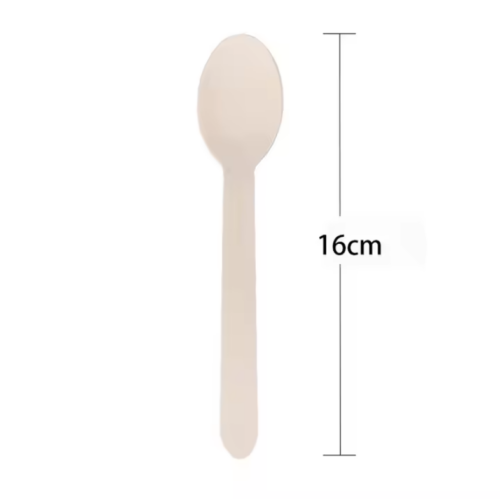
- Freight per unit depends on the carton. Ecoware packs loose single pieces at 1,000 to 5,000 per carton in a carton of about 50 × 35 × 25 cm, which is roughly 0.044 m³, and cutlery sets at 500 sets per 41 × 22 × 39 cm carton, about 0.035 m³. Divide your freight cost per cubic metre by the pieces per cubic metre for the product you are buying: a 0.044 m³ carton of 2,000 pieces is about 45,000 pieces per cubic metre, and one of 5,000 pieces about 114,000. Ask every supplier for the same carton data so the comparison is fair.
Get it confirmed before the first shipment
Classification is the importer’s responsibility. When the product or set is not obvious, ask for an advance ruling:
- United States: search past rulings in CBP’s CROSS database, or request a ruling under 19 CFR Part 177.
- European Union: apply for Binding Tariff Information, valid for three years and binding across the EU (European Commission); existing decisions are in the EBTI database.
- United Kingdom: apply for an Advance Tariff Ruling before clearance; HMRC replies in 30 to 120 days (GOV.UK).
Heading 4419 also matters beyond duty: wooden tableware under 4419 is in scope of the EU Deforestation Regulation, while products made only of bamboo are not. See EUDR due diligence for wooden tableware.
Where this fits
For choosing the supplier in the first place, see how to choose a wooden cutlery manufacturer in China and trading company vs manufacturer. For the material choice that drives the 4419 subheading, see bamboo vs birchwood cutlery for B2B buyers. Whichever supplier you use, ask for each item type to be listed separately on the proforma and commercial invoice with its carton data, so your broker can classify each line; you can put the same request in your quote request to Ecoware.
How this guide was made: drafted with AI assistance and edited by Ecoware’s marketing team on 1 October 2026. Tariff structures were read from the USITC, UK Trade Tariff and EU TARIC databases; valuation, fee and de minimis rules from CBP, U.S. Code, EU and GOV.UK sources, each linked where it is used. No duty rates are given on purpose. This is general guidance, not customs or legal advice. The illustration is generated.
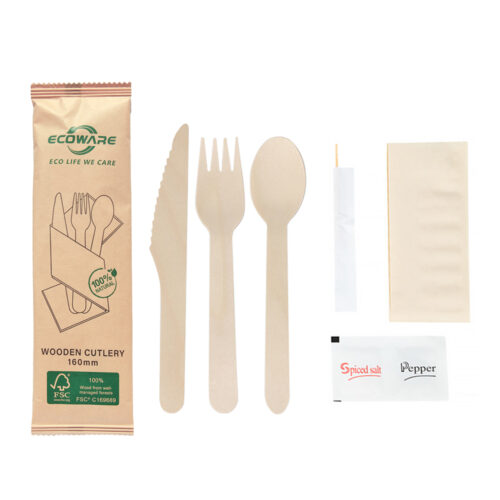
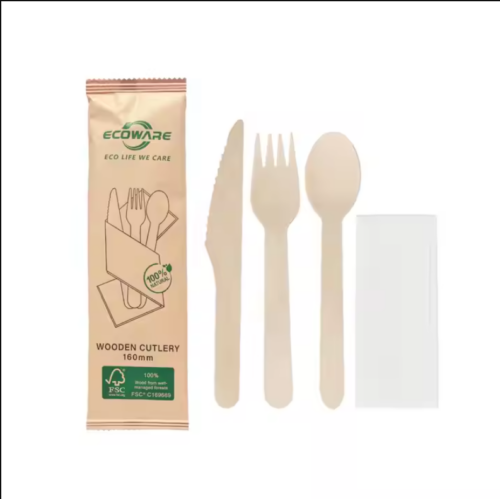
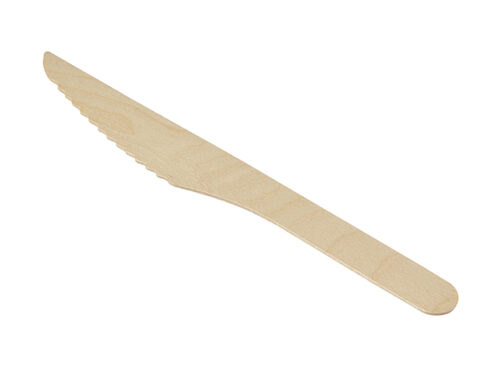
Products in this guide
Related buyer guides
- Biodegradable vs Compostable Cutlery: What Each Label Means and Which One Your Market Accepts
- Pre-Shipment Inspection Checklist for Wooden Cutlery from China: Defects, AQL Sampling and What to Reject
- Home Compostable vs Industrial Compostable Cutlery: The Label Buyers Keep Mixing Up
- Certifications for Disposable Cutlery Suppliers: What FSC, BPI, EN 13432, FDA and LFGB Actually Prove