Updated 30 September 2026. Prepared by Ecoware’s marketing team. Carton and packing figures come from Ecoware’s sales department; regulatory dates link to the government source for each market.
Short answer: Is wooden cutlery better than plastic? On a per-piece invoice, usually not: plastic is the cheaper line. Per order, the gap is smaller than the invoice suggests, and in many markets the comparison no longer exists. The EU, Great Britain (England, Scotland and Wales) and Canada restrict single-use plastic cutlery, so the practical choice there is wood, bamboo, paper or another permitted material, not plastic. In the United States, several states now require utensils to be handed out only on request, which cuts the number of pieces per order whatever material you buy. Wooden cutlery holds up better with hot food than thin polystyrene cutlery, and it is not the item these bans target, unless it carries a plastic coating or component. It is not automatically “compostable” on a label, and it costs more per piece. Work out cost per order with your own numbers, using the method below, before you decide.
Four different questions hide inside “better”
Each of these has a different deciding factor:
| The question you are actually asking | What decides it | Where wood usually lands |
|---|---|---|
| Am I allowed to hand it out? | The single-use plastics law in each market you sell in | Permitted where plastic cutlery is banned |
| Will it cope with the food? | Heat, grease, how long the food sits, how hard the food is to cut | Does not soften with hot food; can feel dry or woody to some customers |
| What does it cost per order? | Unit price × pieces per order, plus freight, storage, and complaints | Higher per piece; the per-order gap depends on how many pieces leave the building |
| What happens after use? | Which bin it goes in locally and whether the label claim is certified | Wood is plant-based; a “compostable” claim still needs a certificate |
Where plastic cutlery is no longer an option
If you operate or sell into these markets, the comparison stops at the first row of the table above.
| Market | What the rule says about plastic cutlery | Source |
|---|---|---|
| European Union | Single-use plastic cutlery may not be placed on the market; the ban has applied since 3 July 2021 under the Single-Use Plastics Directive | European Commission: single-use plastics |
| England | Online and over-the-counter supply of single-use plastic cutlery banned since 1 October 2023, with no exemptions for cutlery | GOV.UK: single-use plastics bans and restrictions |
| Scotland | Supply of single-use plastic cutlery banned since 1 June 2022 | The Environmental Protection (Single-use Plastic Products) (Scotland) Regulations 2021 |
| Wales | Supply of single-use plastic cutlery banned since 30 October 2023 | GOV.WALES: Single-use Plastic Products (Wales) Act 2023 |
| Canada | Manufacture, import and sale of “single-use plastic cutlery” are prohibited; the definition covers cutlery that contains polystyrene or polyethylene, or that changes its physical properties after 100 runs through a household dishwasher. Export of single-use plastic cutlery made in Canada has also been prohibited since 20 December 2025 | Single-use Plastics Prohibition Regulations (SOR/2022-138) |
Canada’s definition is narrower than “all plastic cutlery”: it turns on the polymer and on dishwasher durability, not on the word “disposable”. If you import into Canada, check the product against the definition itself. The EU Single-Use Plastics Directive, the rules in England, Scotland and Wales, and the Canadian regulations all reach items made partly from plastic, so ask your wooden cutlery supplier whether any coating on the pieces is a polymer. For the EU, our guide to EU PPWR and SUP rules for disposable cutlery covers what applies to wooden cutlery and its packaging.
In the United States there is no national ban, but California, Washington and New Jersey make utensils available only when the customer asks, and all three limit pre-bundled kits: California bars bundles that make a customer take a type they did not ask for, Washington does the same for kits packaged in plastic, and New Jersey bars acquiring or handing out multi-type kits from 1 August 2027. The details are in our guide to utensils-upon-request laws. These laws apply to wooden cutlery as much as to plastic. Their effect on cost is the subject of the next section.
Cost per order, not cost per piece
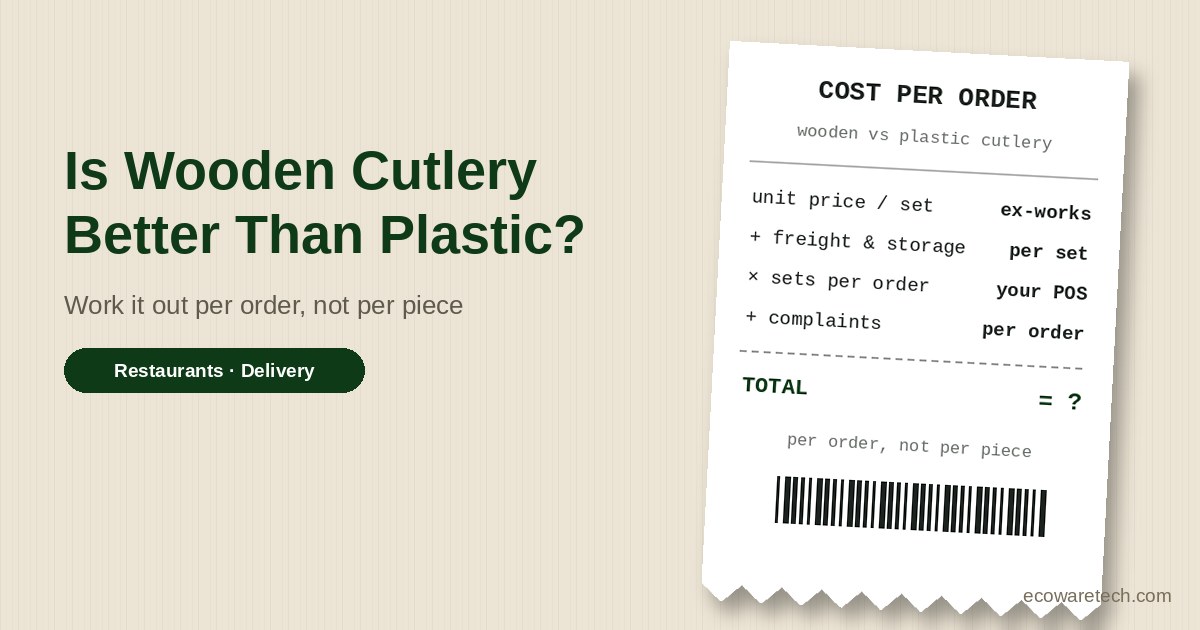
Four inputs turn a per-piece quote into a cost per order:
Cost of cutlery per order = (unit price per set, ex-works or FOB + freight, duty and storage per set) × sets handed out per order + complaint and replacement cost per order
In California, Washington and New Jersey, where kits are restricted, run the same formula per piece rather than per set: a customer who asks for a fork only takes a fork.
Each input behaves differently for wood and plastic:
| Input | How to measure it | What tends to move it |
|---|---|---|
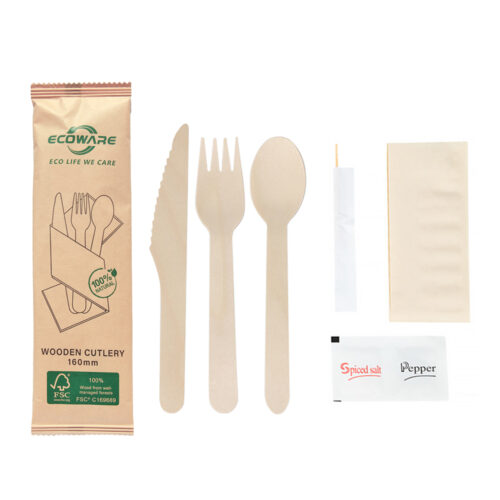
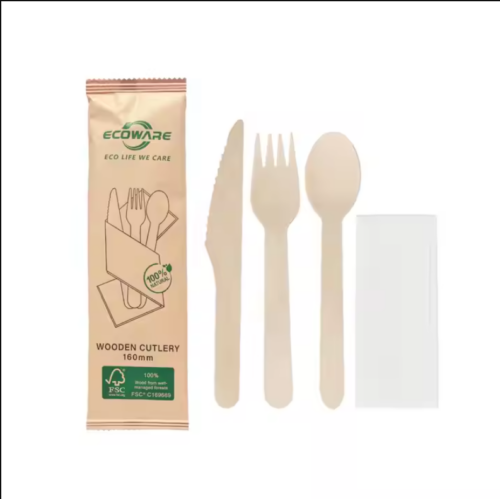
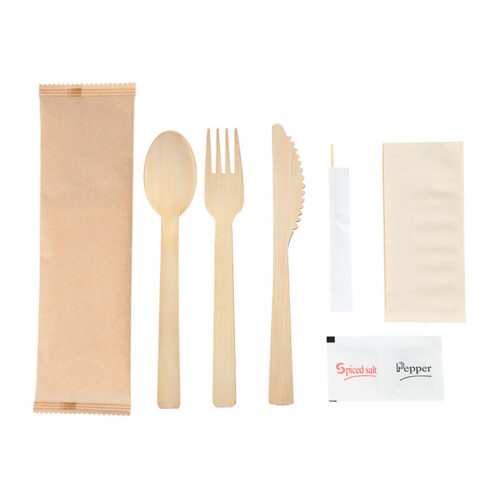
| Unit price per set | Your supplier quotes, ex-works or FOB, for the same set configuration (fork, knife, spoon, napkin) | Material, set size, individual wrapping, printing |
| Sets handed out per order | Sets used in a week ÷ orders in the same week, from your stock count and POS | On-request rules, a “cutlery?” button in your ordering app, whether sets are pre-bagged |
| Freight and storage per set | Carton cube and carton weight ÷ sets per carton, multiplied by your freight and storage rates | Carton spec, how many sets per carton |
| Complaints and replacements | Refunds, remakes and extra sets handed out because a piece broke or bent | Hot, heavy or hard-to-cut dishes; thin or poorly finished pieces |
The second line is where the per-order gap moves most. If your delivery orders used to go out with a set each and an on-request prompt means only some customers ask for one, the sets per order fall for every material you stock. That lowers cutlery cost per order whichever material you choose. Measure it for your own operation: count sets used and orders for two weeks before and two weeks after you add the prompt.
The break-even point needs no market prices, only your two quotes. Wood costs no more per order than your current plastic spend once the sets handed out per order fall by at least 1 − (plastic price per set ÷ wooden price per set). If a wooden set costs 1.5 times a plastic set, that is a fall of one third; at twice the price, a fall of one half. If the same on-request prompt also cuts plastic use, plastic stays cheaper per order by the same ratio, so the break-even matters where you would otherwise keep handing out plastic at today’s rate. Freight and complaints move the line a little either way, which is why the table below gives you the freight inputs.
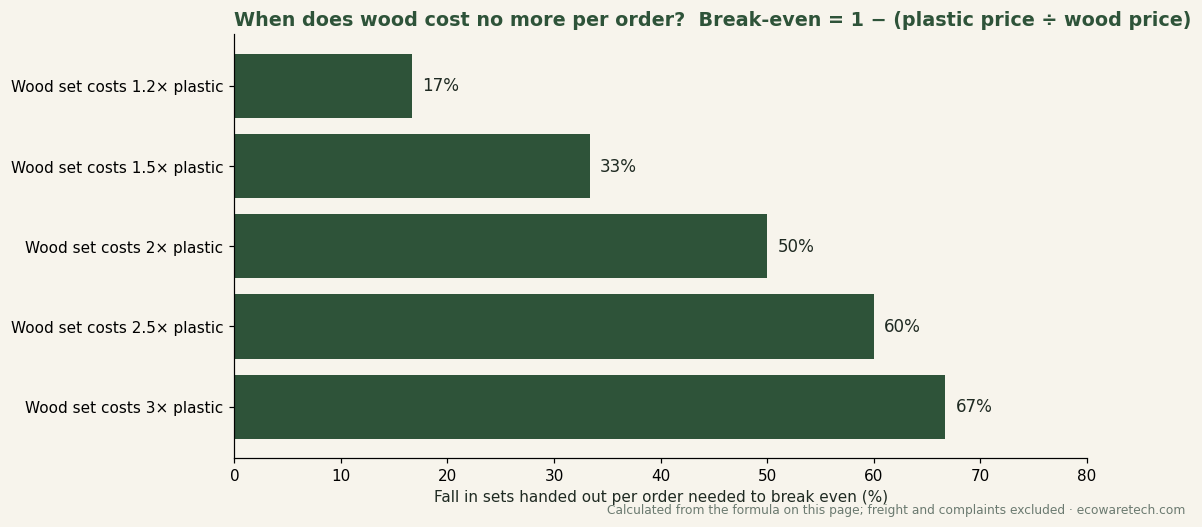
Chart: calculated from the break-even formula above. Freight and complaints are left out. Drawn for this guide; no market prices are used.
Freight and storage: the numbers you can pin down
Freight per set depends on carton cube. For Ecoware’s wooden cutlery sets, packed at 500 sets per carton in a 41 × 22 × 39 cm carton (4 to 7 kg per carton, per our sales department), the arithmetic is:
| Figure | Calculation | Result |
|---|---|---|
| Carton volume | 0.41 m × 0.22 m × 0.39 m | 0.035 m³ |
| Volume per 1,000 sets | 0.035 m³ × 2 cartons | 0.070 m³ |
| Cartons for 10,000 orders at one set each | 10,000 ÷ 500 | 20 cartons, about 0.70 m³ |
| Cartons for 10,000 orders at 0.6 sets each | 6,000 ÷ 500 | 12 cartons, about 0.42 m³ |
| Air-freight chargeable weight per carton | Most air carriers bill the greater of actual weight and volume weight, commonly at a 1:6,000 divisor (about 167 kg per m³); check your forwarder’s | 0.035 m³ ≈ 5.9 kg volume weight, so a 4 kg carton is billed on volume and a 7 kg carton on its actual weight |
Ecoware also packs sets in a 50 × 21 × 34 cm carton (0.036 m³ for 500 sets), so the cube per set is nearly the same in both formats. Ask your plastic supplier for the same three figures, carton dimensions, sets per carton and gross weight, and run the same rows. Without them, two quotes are not comparable on landed cost.
The 0.6 sets per order in the last row is an example of what an on-request prompt could do, not a measured figure. Put your own ratio in its place.
Performance differences that change the cost
These are the situations where the choice of material shows up as refunds or remakes:
- Hot food. Wood doesn’t soften with heat the way thin polystyrene cutlery can; heavier polypropylene holds up better, so compare against the plastic you actually buy. Our guide to using wooden cutlery with hot food covers soups, oily dishes and long delivery times.
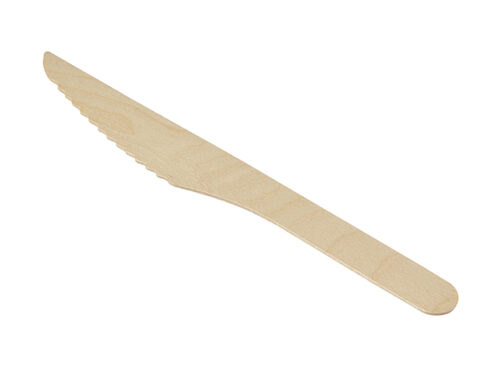
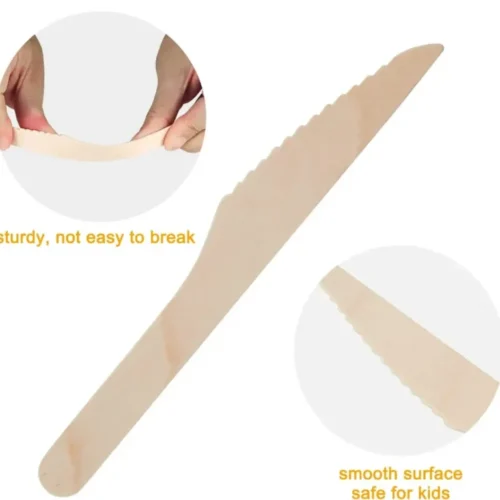
- Finish. Rough edges and raised grain are common complaints about wooden cutlery. They trace back to the sanding stage and can be written into the purchase order; our splinter acceptance checklist gives the wording.
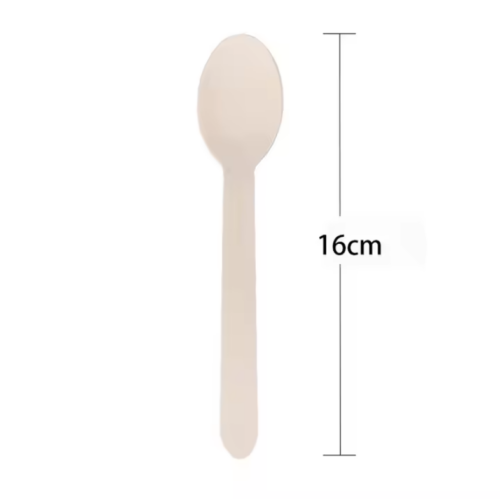
- Taste and mouthfeel. Some customers notice a dry or woody feel, especially with spoons. See whether wooden tableware affects taste.
- Hard-to-cut food. A thin wooden knife struggles where a rigid plastic knife might not. Heavier or reinforced pieces cost more per unit but cut the replacement rate on steak or schnitzel menus; test with your own dishes before choosing.
“Better for the environment” needs a narrower claim
Wood is plant-based and, unlike plastic cutlery, is not the item these bans target unless it carries a plastic coating or component. That does not make it compostable on a label. A “compostable” claim on packaging or on the cutlery itself needs a named certification the customer’s market recognises, and the US Federal Trade Commission’s Green Guides expect environmental claims to be specific and supported. Our compostable certification guide explains which mark applies where.
Life-cycle results depend on what happens after use and on how the wood was dried and transported, so attach any “better for the planet” claim to something you can document, such as FSC-certified wood with a certificate number.
Which way the decision usually goes
| Operation | Market | What usually decides it |
|---|---|---|
| Delivery and takeaway | EU, UK, Canada | Plastic cutlery is restricted; choose among permitted materials on heat performance, finish and cost per order |
| Delivery and takeaway | California, Washington, New Jersey | On-request rules reduce pieces per order for any material; compare per-order cost after the change, counting pieces rather than kits |
| Dine-in with disposables | US states without on-request rules | Unit price matters more because every table uses a set; finish and hot-food performance decide the complaint rate |
| Catering and events | Any | Hot buffets and heavier food favour a material that stays rigid with heat; check whether the client’s brief rules out plastic |
A four-week trial that gives you your own answer
- Weeks 1 and 2: keep your current cutlery. If you are adding an on-request prompt, add it at the start of week 1. Record orders, sets used, and every complaint or replacement related to cutlery.
- Weeks 3 and 4: switch to wooden sets of the configuration you would buy and change nothing else, so the material is the only difference. Record the same three numbers.
- Compare cost per order using the formula above, with your unit prices and the carton figures from each supplier.
- Decide on per-order cost, complaint rate and the legal position in each market you operate.
If you want samples of wooden cutlery sets to run the trial, browse our disposable wooden cutlery sets or send a request with your set configuration. For comparisons with bamboo, see bamboo cutlery vs plastic and comparing bamboo tableware suppliers in China.
Regulatory statements link to the government page for each market and were checked on 30 September 2026; they are a summary, not legal advice. The 0.6 sets-per-order figure is an example input, not a measurement.