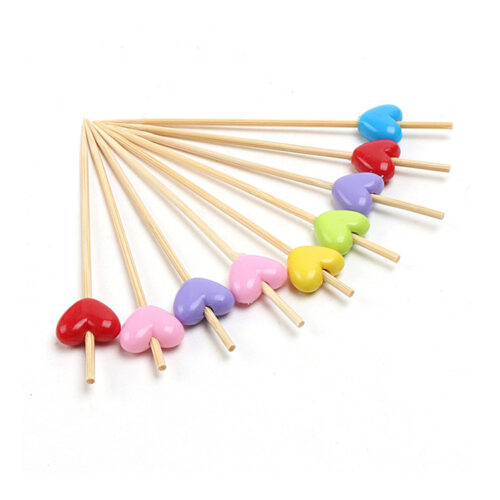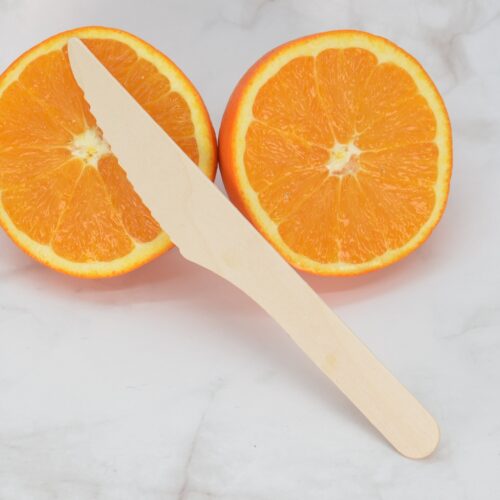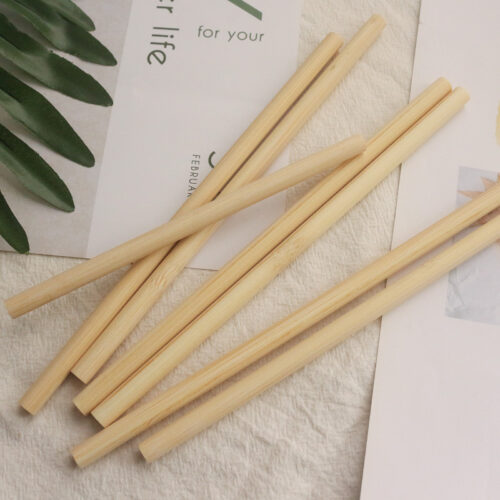
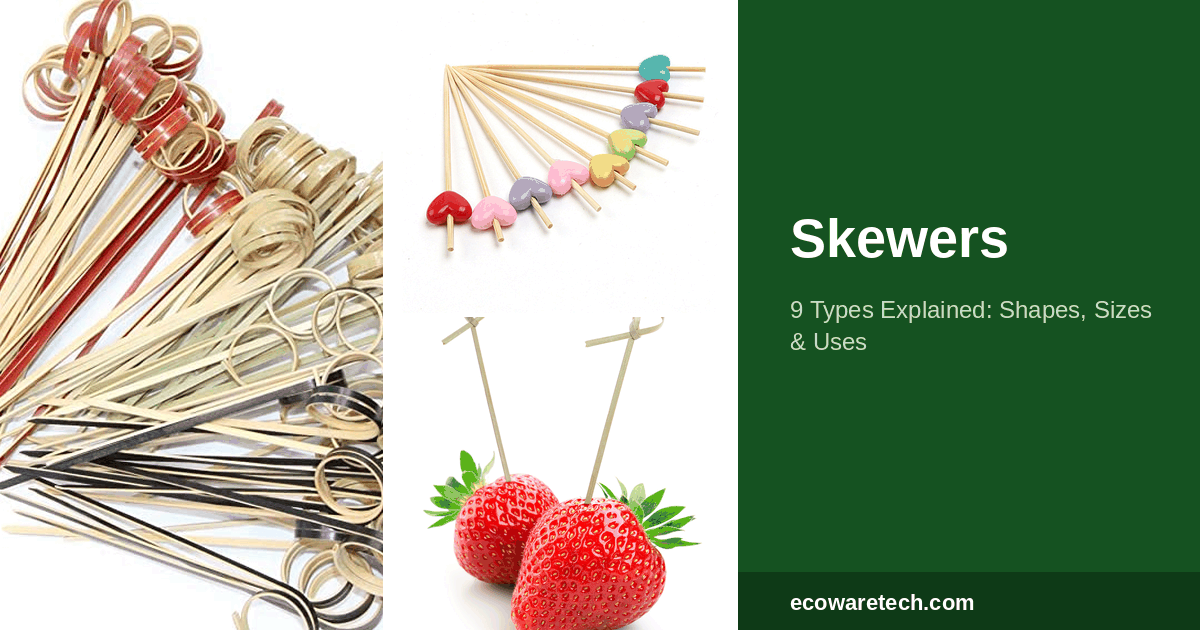
A skewer is a thin stick, usually bamboo or wood, used to hold food together for grilling, roasting, serving or decoration. The shape does real work: round skewers suit general grilling, flat and double-prong skewers stop food from spinning as you turn it, paddle and knotted skewers give a secure grip for appetizers, and teppo, cocktail and fruit picks are sized down for garnish and finger food. This guide covers the 9 shapes buyers ask about most, with real lengths, diameters and the reason each one exists.
Quick Comparison: Skewer Shapes at a Glance
| Shape | Typical length | Typical diameter | Main job |
|---|---|---|---|
| Round skewer | 20-30cm | 3.0-4.0mm | General grilling and kebabs |
| Flat skewer | 15-30cm | n/a (flat profile) | Prevents food from spinning on the grill |
| Paddle skewer | 10-18cm | n/a (flat, widened top) | Easy-grip appetizers and canapes |
| Knotted skewer | 10-15cm | 2.5-3.0mm | Decorative garnish, secure end-grip |
| Loop skewer | 10-15cm | 2.5-3.0mm | Ring-top handle for easy pick-up |
| Double-prong skewer | 20-30cm | 2 x 2.5-3.0mm | Stops food spinning; corn, kebabs |
| Teppo skewer | 10-18cm | n/a (flat, paddle + point) | Cocktail parties, hors d’oeuvres |
| Cocktail pick | 7-10cm | 2.5mm | Garnish, small bites, drinks |
| Fruit pick | 7-12cm | 2.5mm | Fruit platters, dessert display |
Lengths and diameters reflect Ecoware’s own product range and are confirmed against the product pages linked under Related Guides below. Ask your Ecoware contact for the full spec sheet if you need exact tolerances for a purchase order.
A note on “how many skewer types” there really are
Some buying guides round up to a bigger number by counting every length and diameter variant as a separate “type.” This page counts differently: it covers 9 shapes that are genuinely distinct in form and function, each explained on its own below. If your sourcing brief calls for a specific length or diameter combination not shown here, that is a variant within one of these 9 shapes rather than a tenth category, and Ecoware can typically produce it as a custom spec.
Round Skewer
The round skewer is the default: a plain cylindrical stick, tapered to a point at one end. It is the shape most people picture when they hear “skewer,” and it works for the broadest range of foods, from vegetable kebabs to satay to whole shrimp. Its only real limitation is that round, smooth food (whole mushrooms, cherry tomatoes, rounds of sausage) can spin around it as you turn it on the grill, which is where the flat and double-prong shapes below come in.
Flat Skewer
A flat skewer replaces the round cross-section with a flat, blade-like profile. The flat sides grip food from two directions instead of one point of contact, so kebabs stay put when you flip them, an especially useful property for delicate items like fish or tofu that fall apart easily if they twist against a round stick.
Paddle Skewer
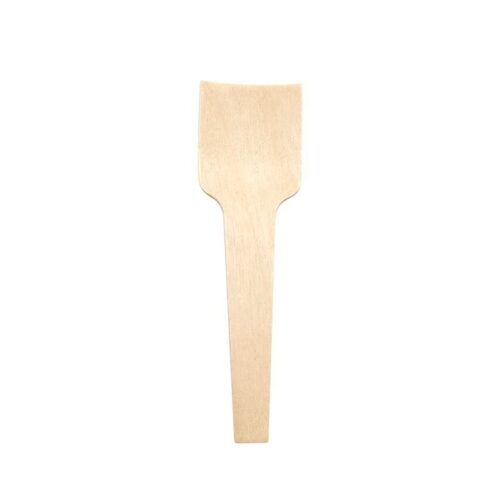
Paddle skewers widen out at one end into a small flat handle, shaped for a comfortable, secure finger grip. That makes them a common choice for cocktail parties and passed appetizers, where a guest needs to pick the skewer straight up off a tray with one hand rather than pinching a thin stick. Hosting a party? Our calculator shows how many skewers to buy per guest.
Knotted Skewer
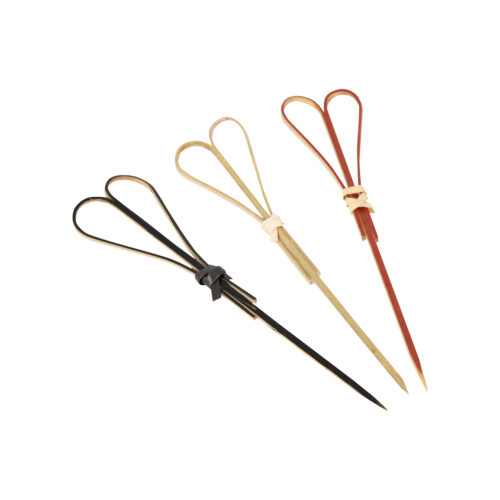
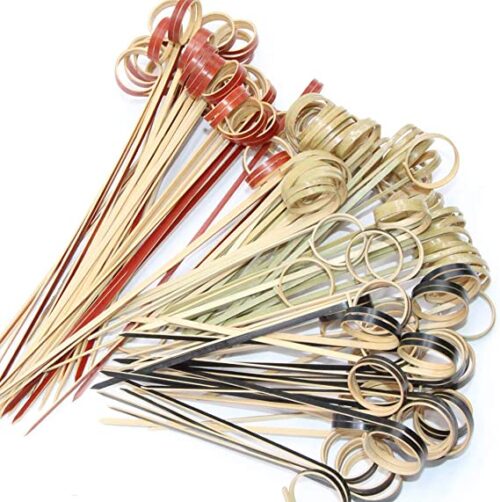
A knotted skewer has one end tied into a small decorative knot rather than left plain. Beyond the visual detail, the knot acts as a stop that keeps food from sliding off the end, which matters for small, light garnishes like a single olive or a cherry that would otherwise work loose.
Loop Skewer
A loop skewer bends one end into a small closed ring instead of a knot or paddle. The ring gives a guest something to hook a finger or thumb through, a shape favored for finger-food service where trays get picked up quickly and a secure hold matters more than a flat grip surface.
Double-Prong Skewer
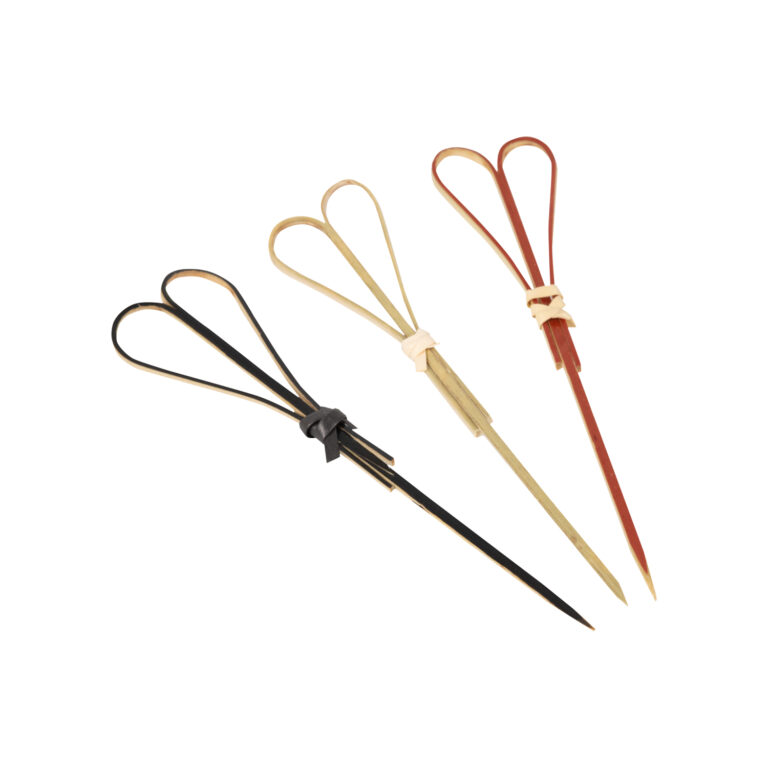
Two parallel prongs, rather than one, pierce the food from opposite sides. The reason is mechanical: with a single skewer, round or irregular food tends to spin freely around the shaft as you turn it, so one side scorches while the other stays raw. Two prongs grip the food from two points and stop that rotation, giving even heat exposure on all sides. This is the shape most often recommended for corn on the cob and larger kebab pieces that would otherwise twist.
Teppo Skewer
Teppo skewers pair a flat paddle grip on one end with a sharpened point on the other, and often use a squared-off rather than round shaft, which, like the double-prong design, helps stop food from spinning in place. They are sized for small bites: hors d’oeuvres, sandwich wedges, fruit garnish in a cocktail glass, and other cocktail-party finger food rather than full kebabs.
Cocktail Pick
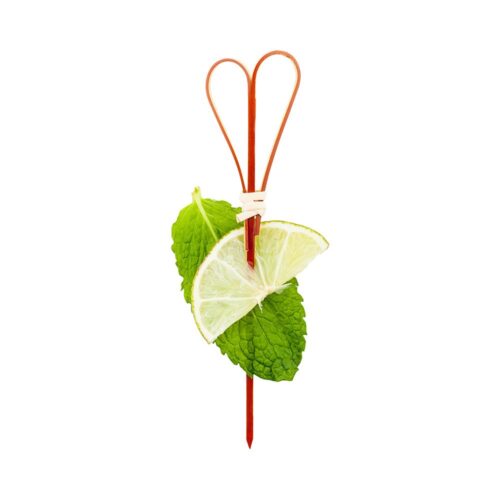
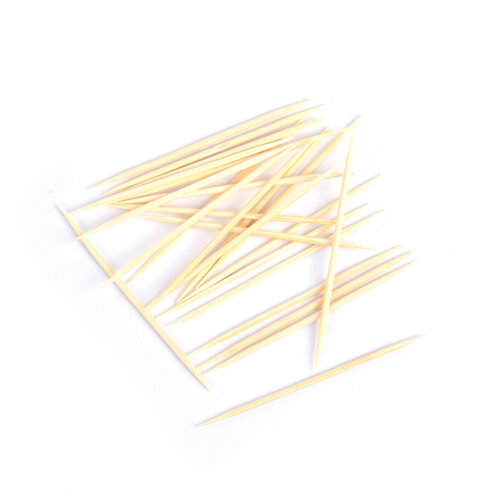
A short, thin pick, typically pointed at one end and sometimes decoratively finished at the other, sized for a single olive, cheese cube or cocktail garnish rather than a full skewer’s worth of food. Bars and catering services buy these separately from full-length skewers precisely because a 25cm round skewer is impractical for a single garnish.
Fruit Pick
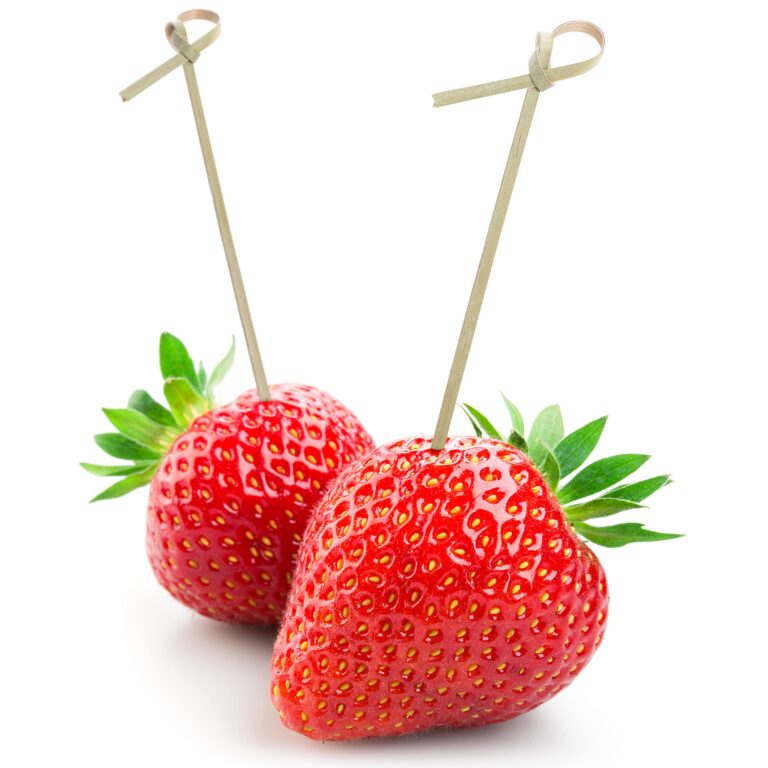
Similar in scale to a cocktail pick but generally intended for fruit platters and dessert display rather than drinks: a short, food-safe point sized for a strawberry, melon cube or grape. The distinction from a cocktail pick is mostly one of marketing and typical use case rather than a fundamentally different shape.
Why Bamboo Skewers Need Soaking Before Grilling
Bamboo and wooden skewers are flammable, and soaking them in water before grilling gives the wood something other than itself to burn: the trapped moisture has to evaporate before the wood starts to char. The Kitchn puts the sweet spot at roughly 30 minutes for most recipes, with a shorter 10-minute soak acceptable for quick-cooking food and up to an overnight soak for longer, slower cooks. Skip the soak and the exposed sections of skewer between pieces of food will char and can burn through entirely, which is both a food-safety and a burnt-food problem.
Frequently Asked Questions
What are skewers used for?
Skewers hold pieces of food together for grilling, roasting, serving or garnish. The shape changes depending on the job: round and double-prong skewers are built for grilling kebabs, while paddle, teppo, cocktail and fruit picks are sized and shaped for serving small bites and garnishes.
What is the difference between a skewer and a cocktail pick?
Mainly length and job. A skewer is typically 15-30cm and built to hold a full kebab’s worth of food for cooking. A cocktail pick or fruit pick is 7-12cm, meant for a single garnish or bite rather than a full skewer of food.
Why do bamboo skewers need to be soaked in water?
Soaking (about 30 minutes for most recipes) lets the bamboo absorb moisture that has to evaporate before the wood can catch fire on a hot grill. Unsoaked skewers char and can burn through at any exposed section between pieces of food.
What is a double-prong skewer for?
The second prong stops food from spinning around the skewer as you turn it, which keeps round or irregular items like corn on the cob or large kebab pieces cooking evenly on all sides instead of scorching on one side.
What is a teppo skewer?
A short bamboo pick with a flat paddle grip on one end and a point on the other, often with a squared shaft to resist spinning. It is sized for cocktail-party finger food such as hors d’oeuvres, sandwich wedges and cocktail garnishes rather than full kebabs.
What sizes do skewers come in?
Ecoware’s range runs from short 7-10cm cocktail and fruit picks up to 30cm round and double-prong skewers for full kebabs, in diameters from about 2.5mm up to 4.0mm depending on shape. See the comparison table above for shape-by-shape figures.
Related Guides in This Series
This page is the pillar for Ecoware’s bamboo-pick content. It links back to the site’s main tableware classification guide and to the real product pages for each skewer and pick category.
- Types of Chopsticks: 9 Styles Explained (Sizes & Uses): the companion classification guide for chopsticks, including regional length and tip differences.
- Types of Toothpicks: 7 Styles Explained: the companion guide to Ecoware’s shorter bamboo picks, including how they differ from cocktail picks.
- Types of Coffee Stirrers: 5 Materials Compared: covers wood, bamboo, plastic, metal and paper stirrers, plus length by cup size.
- Types of Spoons: 18 Kinds Explained (Sizes & Uses): Ecoware’s main tableware classification pillar, covering the disposable spoon range.
- Types of Forks: 15 Kinds Explained (Sizes & Uses): the equivalent classification guide for disposable forks.
- Disposable Bamboo Skewers: the full skewer and pick product range, including knotted, loop and paddle shapes.
- Bamboo Fruit Skewers: the short fruit and cocktail pick range for platters and drinks service.
About Ecoware
Ecoware Co., Ltd. sells disposable wooden and bamboo tableware made at its family factory in Shucheng, Anhui province, China (Shucheng Limin Wood Products Co., Ltd., established 2008). The company supplies FSC Chain-of-Custody certified birch and bamboo product lines alongside food-contact compliance documentation (FDA 21 CFR 176.170, EU 10/2011 and LFGB testing on request) for import buyers who need paperwork ready before a shipment clears customs.
The figures in this guide come from a mix of independently published data cited inline, Ecoware’s own product specifications published on ecowaretech.com, and standard-setting bodies. Where a number could not be independently verified, this guide says so rather than estimating one, and points you to where you can request the missing spec sheet directly from Ecoware.
Sourcing skewers or picks at volume? Request a quote →