
Updated 16 October 2026. Prepared by Ecoware’s marketing team. Rules and study results link to the regulator or the published paper.
Short answer: Yes, wooden plates are safe to eat on when they are made of a hard, close-grained wood or solid bamboo, have no finish or only a food-safe one, and are kept clean, dry and free of cracks. The US FDA Food Code allows hard maple “or an equivalently hard, close-grained wood” for utensils, including salad bowls (FDA Food Code 2022, section 4-101.17). The code does not name bamboo; the EU, UK and Irish warnings on bamboo concern bamboo-filled plastic, not items made solely of bamboo (is bamboo melamine safe). In a University of Wisconsin cutting-board study, fewer bacteria were generally recovered from clean wood than from plastic (Ak, Cliver and Kaspar, 1994). The real risks are an unnamed finish, “bamboo” plates that are actually melamine resin, and cracks or mould.
What decides whether a wooden plate is safe
Four checks decide most of it, and a fifth applies when the plate is disposable:
| Question | Safer answer | What to watch for |
|---|---|---|
| What wood is it? | A hard, close-grained wood such as maple, the species the FDA Food Code names; bamboo with a smooth, sound surface | Soft, open-grained wood is harder to keep clean |
| What finish is on it? | None, or a food-safe oil or coating the maker can name | Unnamed lacquer or paint; plates sold as “bamboo” that are really melamine resin |
| What condition is it in? | Smooth, dry, no smell | Cracks, deep knife marks, mould spots |
| How is it used? | Serving and eating, then washed and dried | Soaking, long contact with very hot, wet or oily food |
| Reusable or disposable? | Disposable plates used once; reusable plates cared for | Reusing a thin disposable plate after it has absorbed liquid |
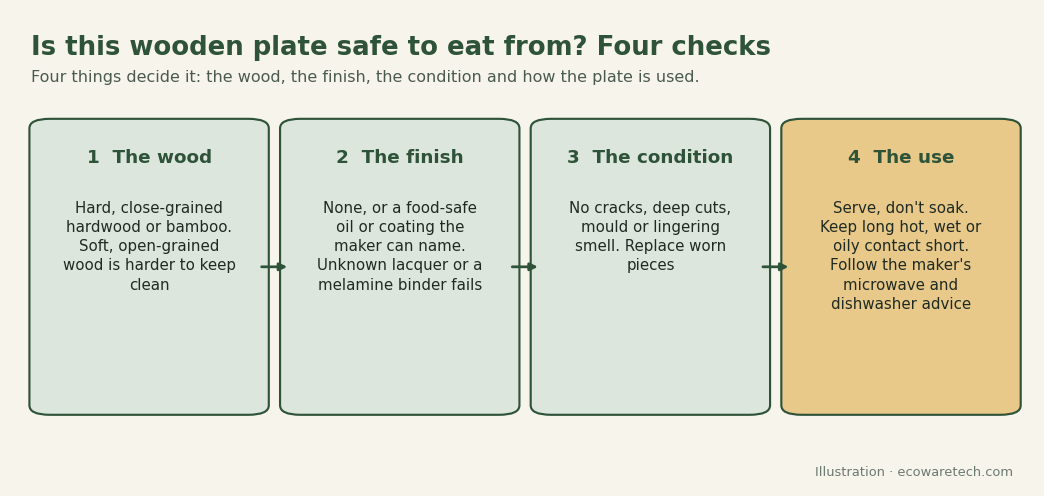
Illustration: the four main checks in the table above. Generated for this guide.
Wooden plates vs plastic, melamine, metal and ceramic
Every plate material has its own food-contact concern, and the rules that address each one differ:
| Plate material | Main food-contact concern | What the rules or studies say |
|---|---|---|
| Wood or solid bamboo | The finish and the surface condition | Hard, close-grained wood is accepted for utensils, including salad bowls; preservative-treated wood is restricted (FDA Food Code 2022, 4-101.17) |
| Plastic | Bisphenols such as BPA | The EU banned BPA and other hazardous bisphenols in food-contact plastics, varnishes and coatings from 20 January 2025; most non-compliant articles could stay on the market until 20 July 2026 (EU, Regulation (EU) 2024/3190) |
| Melamine, including “bamboo” melamine | Melamine and formaldehyde released by heat | In Germany’s official tests, 31% of bamboo-ware samples exceeded the EU 15 mg/kg formaldehyde limit by the third test, against 5.8% of conventional melamine items (BfR); the FDA advises against microwaving food on melamine dinnerware (FDA) |
| Ceramic and china | Lead in glazes and decoration | Ceramic tableware must be lead-free or within FDA limits; for flat tableware such as plates the limit is 3.0 mg/L (FDA Food Code 2022, 4-101.13) |
| Metal | Depends on the alloy | Pewter with more than 0.05% lead may not touch food; copper and brass may not hold food with a pH below 6; galvanised metal may not hold acidic food (FDA Food Code 2022, 4-101.13 to 4-101.15) |
An uncoated wooden plate has no glaze, resin or coating layer, so the chemical questions in this table come down to its finish. Wood’s trade-offs are moisture and wear, covered below. That is also the honest answer to whether a wooden plate is good for health: it is a neutral choice rather than a health product, and the rules above treat clean, hard wood as acceptable.
What food safety rules say about wood
United States. The FDA Food Code, the model code that US states adopt for restaurants and retail food businesses, does not allow wood as a food-contact surface in general, then makes exceptions. Hard maple “or an equivalently hard, close-grained wood” may be used for cutting boards, bakers’ tables and utensils, and the list of utensils names salad bowls and chopsticks (FDA Food Code 2022, section 4-101.17). The reason given in the code’s annex is practical: moist foods can make a wood surface deteriorate and become hard to clean, and wood treated with preservatives can pass those chemicals into food, so only specific preservatives are allowed.
For single-use items, which is where disposable wooden plates sit, the same code says the material must not let harmful substances migrate into food, must not give food a colour, smell or taste, and must be safe and clean (FDA Food Code 2022, section 4-102.11).
European Union. Wood has no EU-wide specific rules for food contact. The general rules of Regulation (EC) No 1935/2004 apply: a material must not transfer its constituents to food in quantities that could endanger health or change the food unacceptably. Member states can add national rules, as a 2016 review of wood in contact with food notes.
China. For bamboo and wood food-contact products sold in China, the national standard GB 4806.12-2022 for bamboo and wood food-contact materials has applied since 30 December 2022 and sets migration limits, including for heavy metals.
Is wood hygienic, or does it trap bacteria?
In laboratory tests on cutting-board blocks, clean hard wood held fewer recoverable bacteria than plastic; no cited study tested plates.
- In the University of Wisconsin study, bacteria applied to plastic blocks were readily recovered and multiplied overnight, while recovery from wooden blocks was generally lower and fell further with time. When large numbers were applied, counts on wood were cut by at least 98% within 12 hours. Oiling the wood with mineral oil made little difference (Ak, Cliver and Kaspar, Journal of Food Protection, 1994).
- A 2016 review of 20 years of studies concluded that the porous nature of wood is not what limits its hygiene, that its surface often creates poor conditions for microorganisms, and that wood produces compounds that can limit pathogen growth (Aviat et al., Comprehensive Reviews in Food Science and Food Safety, 2016).
Wood is still not self-cleaning. A cracked, damp or greasy plate is a different surface from the clean blocks in those studies. The Food Code’s own reasoning points the same way: moist food can make a wood surface deteriorate and become hard to clean, so a worn piece should be replaced.
Finishes, coatings and melamine: what is on the wood
Many questions about whether wooden tableware is toxic are really questions about what is on the wood:
- Oil and wax finishes are common on reusable wooden plates and bowls. Ask the maker which one is used and whether it is sold for food contact.
- Lacquers, paints and varnishes should come with evidence that the coating is permitted for food contact in your market. If the seller cannot name the coating, do not use it for food.
- “Bamboo” plates and cups that feel like smooth plastic are often melamine-formaldehyde resin with bamboo filler. They are not solid bamboo, they are not authorised in the EU, and hot food can draw melamine and formaldehyde out of them. See is bamboo melamine safe.
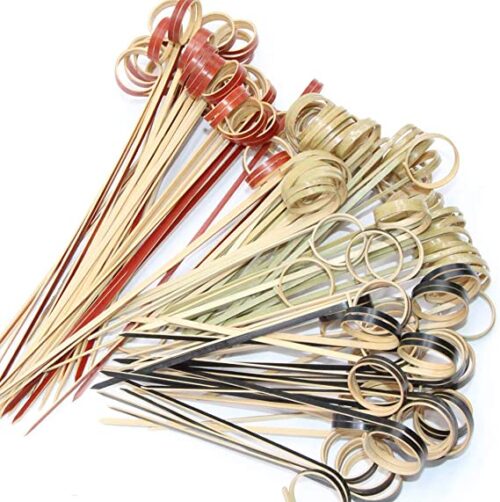
- Uncoated disposable plates made from wood veneer or bamboo have no finish layer. Ask whether any bleaching or sulphur treatment was used: Hong Kong’s Consumer Council found sulphur dioxide in 17 of 18 bamboo toothpick and skewer samples it tested, all within the mainland Chinese limit for bamboo chopsticks but five above a stricter draft limit for toothpicks (Consumer Council, 2011).
Disadvantages of wooden plates
The disadvantages of wooden plates are absorption, cracking, upkeep, mould when stored damp, and softening of thin disposable plates. Most are durability problems; mould is a hygiene risk. Together they decide where wooden plates work:
| Drawback | Why it happens | What to do |
|---|---|---|
| Absorbs liquid, stains and smells | Wood takes up moisture through the grain | Wipe spills quickly; avoid soaking |
| Can crack or warp | Repeated wetting and drying, or high heat | Hand wash, dry upright; follow the maker’s dishwasher advice |
| Needs upkeep | Oil finishes wear off with washing | Re-oil reusable plates when the surface looks dry |
| Can grow mould if stored damp | Moisture plus warmth | Store dry and ventilated; discard mouldy pieces |
| Thin disposable plates soften under wet or oily food | Veneer absorbs liquid over time | Match plate thickness to the food and serving time |
Mould is a storage question as much as a material one. Hong Kong’s Consumer Council found mould counts above the reference level in two of eight bamboo skewer samples it tested in 2011 and advised storing bamboo products dry and discarding mouldy ones (Consumer Council, 2011). Our guide to mould on wooden cutlery covers moisture control in more detail.
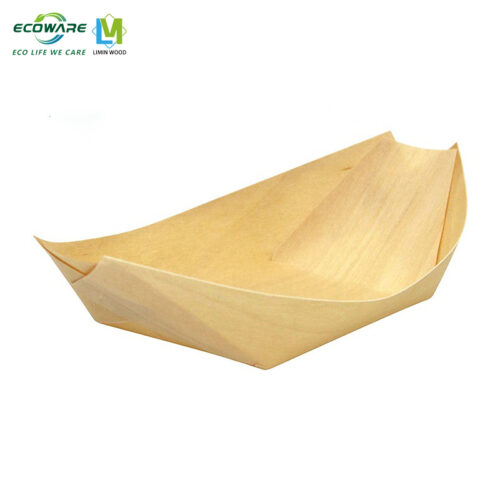
For plate shapes and load limits in foodservice, see wooden plates vs wooden boats, and for heat, can disposable wooden cutlery be used for hot food.
Buying disposable wooden plates for a business
If you are buying disposable wooden plates and boats by the carton rather than for your own kitchen, safety becomes a documentation question. Ask the supplier for:
- The material in writing: wood species or bamboo, and a statement that no coating, glue or binder is used, or which one is.
- A food-contact test report for your market, from an accredited laboratory, naming the test conditions and date.
- Moisture and mould controls: how the plates are dried, packed and stored before shipping.
- Certificates you actually need, such as FSC for a sourcing claim. Our guide to certifications for disposable cutlery suppliers explains what each one proves, and our factory page lists the certificates our factory holds.
For the materials themselves, read what wood is wooden cutlery made of.
Common questions
Are wooden bowls safe to eat from? Wooden bowls are safe to eat from on the same conditions as plates. The FDA Food Code names salad bowls among the wooden utensils it accepts when the wood is hard and close-grained.
How can you tell if a wooden bowl is food safe? A wooden bowl is food safe when it is hard, close-grained wood or solid bamboo, the seller can name a finish permitted for food contact, and the surface has no cracks or mould. A bowl that feels like smooth plastic, with moulded shapes and bright colours, is probably melamine resin with bamboo filler.
Is wood microwave safe? None of the rules cited here covers microwaving wood. Do not microwave a wooden plate unless its maker says it is suitable.
Can wooden plates go in the dishwasher? Long hot, wet cycles are what crack wood and strip oil finishes, and the Food Code notes that moisture can make wood deteriorate. Hand wash and dry unless the maker rates the piece as dishwasher-safe.
Are wooden plates safe for babies and toddlers? The rules above set no separate limits for children’s wooden tableware, so the same checks apply. Look harder at the finish and at cracks or rough edges that could splinter.
Are wooden camping plates a good choice for outdoor meals? For dry or briefly served food, yes. Thin disposable plates soften under wet or oily food over time, and any wooden plate should be dried before it is packed away.
Where Ecoware fits
Ecoware Co., Ltd. is the export company of the factory Shucheng Limin Wood Products Co., Ltd., which makes single-use wooden plates and boats for foodservice, along with wooden and bamboo cutlery. If you need plates for a specific market, tell us the market and the food when you request a quote, and ask for the material declaration and test report with it.
How this guide was made: drafted with AI assistance and edited by Ecoware’s marketing team in October 2026. Rules come from the FDA Food Code 2022, EU Regulation 1935/2004, the EU bisphenol rules and China’s national standard as summarised by the Food Packaging Forum; hygiene findings from the two peer-reviewed papers linked above; melamine findings from BfR and the FDA. No product testing was carried out for this article. The illustration is generated.
Related Articles
- EUDR and Wooden Tableware: What EU Buyers Will Ask For
- Does Wooden Tableware Need an ISPM 15 Certificate?
- The 2025 EU Single-Use Plastics & PPWR Guide for Tableware Purchasers
- Wooden Cutlery Manufacturers in China: How to Vet a Factory (2026)
- What Wood Is Wooden Cutlery Made Of? Reuse and Decomposition Explained
- Browse all articles & products →